
Super-Jupiters Challenge Planet Size Limits
#Super-Jupiter #Exoplanets #James Webb Space Telescope #HR 8799 system #Planetary formation #Brown dwarfs #Nature Astronomy #UC San Diego
📌 Key Takeaways
- Scientists discovered super-Jupiter exoplanets with masses 5-10 times that of Jupiter
- JWST detected multiple molecules including sulfur in these exoplanets for the first time
- The findings challenge existing models of planetary formation
- The research helps determine the limits of planetary sizes and distinguishes planets from brown dwarfs
📖 Full Retelling
🏷️ Themes
Exoplanets, Planetary Formation, Space Exploration
📚 Related People & Topics
Exoplanet
Planet outside of the Solar System
An exoplanet or extrasolar planet is a planet outside of the Solar System. The first confirmed detection of an exoplanet was in 1992 around a pulsar, and the first detection around a main-sequence star was in 1995. A different planet, first detected in 1988, was confirmed in 2003.

Brown dwarf
Type of substellar object more massive than a planet
Brown dwarfs are substellar objects that have more mass than the biggest gas giant planets, but less than the least massive main-sequence stars. Their mass is approximately 13 to 80 times that of Jupiter (MJ)—not big enough to sustain nuclear fusion of hydrogen into helium in their cores, but massi...

Nebular hypothesis
Astronomical theory about the Solar System
The nebular hypothesis is the most widely accepted model in the field of cosmogony to explain the formation and evolution of the Solar System (as well as other planetary systems). It suggests the Solar System is formed from gas and dust orbiting the Sun which clumped up together to form the planets....
Nature Astronomy
Academic journal
Nature Astronomy is a peer reviewed scientific journal published by Nature Portfolio. It was first published in January 2017 (volume 1, issue 1), although the first content appeared online in December 2016. The editor-in-chief is Paul Woods, who is a full-time professional editor employed by the jou...

James Webb Space Telescope
NASA/ESA/CSA space telescope launched in 2021
The James Webb Space Telescope (JWST) is a space telescope designed to conduct infrared astronomy. It is the largest telescope in space, and is equipped with high-resolution and high-sensitivity instruments, allowing it to view objects too old, distant, or faint for the Hubble Space Telescope. This ...
Entity Intersection Graph
Connections for Exoplanet:
Mentioned Entities
Deep Analysis
Why It Matters
This research challenges fundamental models of planet formation by showing gas giants can form with much larger sizes and different compositions than previously understood. These findings help distinguish between planets and brown dwarfs, refining the search for habitable worlds and advancing our knowledge of planetary system evolution.
Context & Background
- Jupiter is the largest planet in our solar system at 11 times Earth's radius and 318 times its mass
- Exoplanet discoveries have revealed planets with masses 5 to 10 times greater than Jupiter
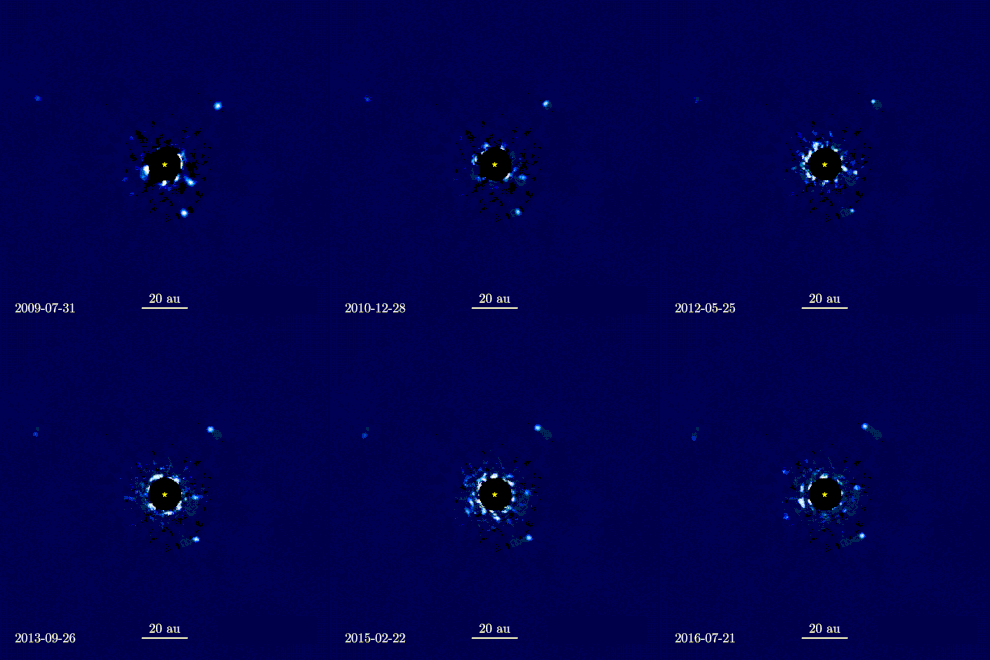
- The study used JWST to analyze three gas giants in the HR 8799 system 133 light-years away
What Happens Next
Scientists will continue refining planetary formation models to account for larger gas giants and their formation processes. Future JWST observations will likely target more super-Jupiters to determine size limits and better understand the planet-brown dwarf transition.
Frequently Asked Questions
Super-Jupiters are planets that form like gas giants, while brown dwarfs are substellar objects that failed to become stars, typically being larger and forming differently.
JWST analyzed atmospheric compositions of distant exoplanets, detecting water, carbon monoxide, methane, and sulfur to understand their formation.
Sulfur detection helped confirm the objects were planets rather than brown dwarfs, providing key evidence for their formation history.