
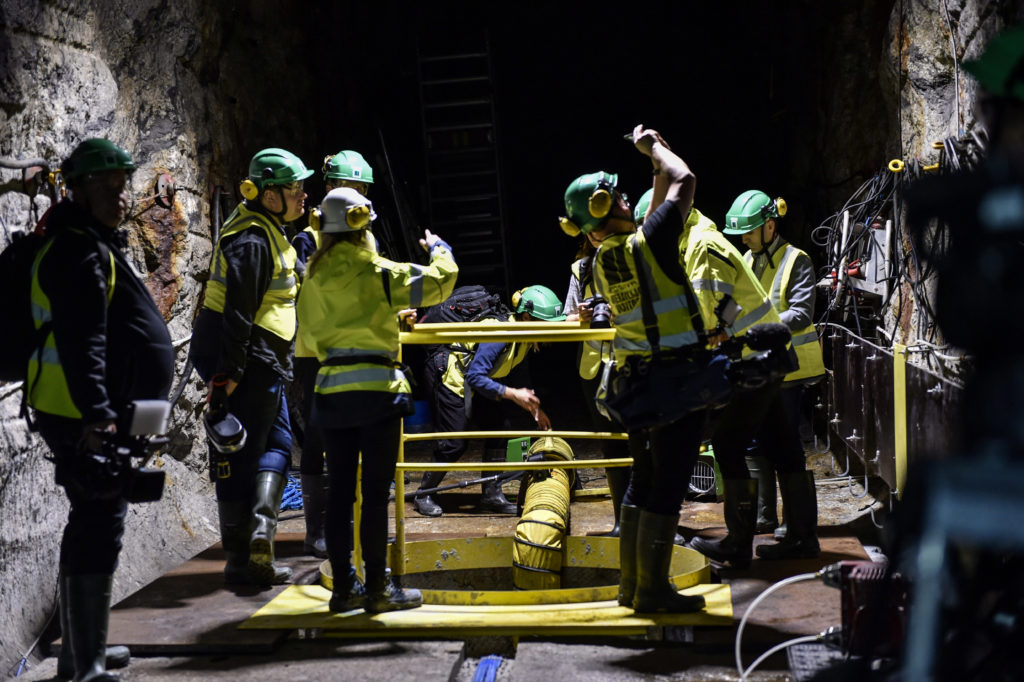
This 1.9 billion-year-old bedrock will soon house the world's 1st permanent nuclear waste site
#nuclear waste repository #Onkalo facility #Finland #spent nuclear fuel #geological disposal #Posiva Oy #radioactive waste management #Olkiluoto Island
📌 Key Takeaways
- Finland's Onkalo facility will become the world's first permanent geological repository for spent nuclear fuel
- The repository is built within 1.9-billion-year-old bedrock at 430 meters depth for maximum geological stability
- Operations are scheduled to begin in the mid-2020s after nearly two decades of construction
- The project represents a solution to nuclear energy's long-term waste storage challenge
📖 Full Retelling
🏷️ Themes
Nuclear Energy, Environmental Safety, Technological Innovation
📚 Related People & Topics

Finland
Country in northern Europe
Finland, officially the Republic of Finland, is a Nordic country in Northern Europe. It borders Sweden to the northwest, Norway to the north, and Russia to the east, with the Gulf of Bothnia to the west and the Gulf of Finland to the south, opposite Estonia. Its capital and largest city is Helsinki.
Entity Intersection Graph
Connections for Finland:
Mentioned Entities
Deep Analysis
Why It Matters
This development is crucial because it provides the first operational solution to the decades-long global problem of safely disposing of high-level nuclear waste, which remains dangerous for millennia. It validates the feasibility of the 'deep geological repository' concept, offering a blueprint for other nuclear-powered nations that are struggling with waste management. The success of Onkalo demonstrates how political stability and transparent community engagement can overcome the significant public opposition often associated with nuclear projects.
Context & Background
- Nuclear waste remains hazardous to human health for hundreds of thousands of years, requiring isolation from the biosphere.
- The concept of deep geological disposal has been studied globally since the mid-20th century, but Finland is the first to successfully construct and implement such a facility.
- Site selection for Onkalo began in the 1980s, involving extensive geological surveys to find stable crystalline rock formations.
- Posiva Oy, the company responsible for the facility, is owned by Finnish nuclear power companies Teollisuuden Voima and Fortum.
- The United States has struggled to implement a similar repository at Yucca Mountain due to political and legal opposition, highlighting Finland's unique achievement.
What Happens Next
Operations are scheduled to begin in the mid-2020s, initiating the process of placing canisters into the deposition holes. The filling and sealing process is expected to take approximately 100 years to complete. Following this, the facility will be permanently backfilled and sealed, with the surface restored to its natural state. Other nations, particularly Sweden and France, are expected to move forward with their own repository projects based on Finland's regulatory and technical framework.
Frequently Asked Questions
The depth of 430 meters ensures that the waste is isolated from surface environmental changes, such as climate shifts or human activity, and utilizes the stable bedrock as a natural barrier.
Spent nuclear fuel remains highly radioactive and hazardous to human health for hundreds of thousands of years, necessitating a containment solution that lasts on a geological timescale.
The fuel is encapsulated in copper and cast iron canisters, which are then placed in holes lined with bentonite clay that swells when wet to create a protective seal.
The facility has a capacity to store approximately 6,500 tons of spent fuel, which is enough to handle Finland's entire existing inventory and future production.