
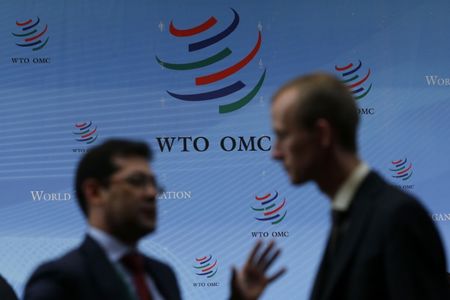
U.S. and India remain split on WTO e-commerce moratorium extension
#WTO #E-commerce moratorium #Digital tariffs #U.S.-India trade #Yaoundé summit #Electronic transmissions #Trade barriers #Market predictability
📌 Key Takeaways
- U.S. and India remain divided on extending the WTO e-commerce moratorium
- U.S. seeks permanent ban while India accepts only two-year extension
- Business leaders warn failure to extend would trigger new duties on digital trade
- The outcome is seen as a test of the WTO's relevance in global trade
- Broader institutional reforms are also being discussed alongside the e-commerce moratorium
📖 Full Retelling
🏷️ Themes
International Trade, Digital Economy, WTO Reform
📚 Related People & Topics
Trade barrier
Restrictions limiting international trade
Trade barriers are government-induced restrictions on international trade. Most trade barriers work on the same principle: the imposition of some sort of cost (money, time, bureaucracy, quota) on trade that alters the price or availability of the traded products. Barriers take the form of tariffs (...

World Trade Organization
Intergovernmental trade organization
The World Trade Organization (WTO) is an intergovernmental organization that regulates and facilitates international trade. Established on 1 January 1995, pursuant to the 1994 Marrakesh Agreement, it succeeded the General Agreement on Tariffs and Trade (GATT), which was created in 1948. As the world...
Entity Intersection Graph
Connections for Trade barrier:
Mentioned Entities
Deep Analysis
Why It Matters
This news is important because the outcome of the WTO e-commerce moratorium extension will significantly impact the digital economy's regulatory framework and the future relevance of the WTO itself. A failure to extend the moratorium could trigger a wave of new tariffs on digital goods and services, disrupting global e-commerce that has flourished under the current tariff-free environment. The disagreement between the U.S. and India represents a broader challenge to the multilateral trading system as countries increasingly diverge on digital trade rules and the WTO's role in governing them.
Context & Background
- The WTO moratorium on tariffs on electronic transmissions has been in place since 1998, creating a tariff-free environment for digital goods and services.
- The moratorium has been periodically extended, most recently in 2019, but has faced increasing challenges as digital trade has grown exponentially.
- India has traditionally been cautious about digital trade liberalization, concerned about protecting its domestic industries and digital sovereignty.
- The U.S. has been a strong proponent of permanent digital trade liberalization, viewing it as essential for maintaining American competitiveness in the tech sector.
- The WTO has been facing broader challenges to its relevance, with many major powers pursuing bilateral and regional trade agreements outside the multilateral framework.
- Digital trade has become increasingly contentious as countries develop competing approaches to data governance, cross-border data flows, and digital taxation.
What Happens Next
The WTO members will continue negotiations in Yaoundé, Cameroon, with the current moratorium set to expire by the end of March 2026. If no agreement is reached, the moratorium will lapse, potentially allowing members to impose tariffs on electronic transmissions. The U.S. has indicated that a permanent extension is vital for maintaining its confidence in the WTO's effectiveness, suggesting that a failure to reach a permanent deal could lead to reduced U.S. engagement with the organization. Diplomats may explore compromise options, though the significant gap between the U.S. (permanent) and India (two-year) positions makes a resolution challenging.
Frequently Asked Questions
The moratorium is a standing agreement at the World Trade Organization that prohibits members from imposing customs duties on electronic transmissions, which includes digital products like software, e-books, and streaming services. It has been in place since 1998 to ensure the digital economy develops without tariff barriers.
The U.S. seeks a permanent extension to maintain long-term market predictability for its tech companies, while India is advocating for only a two-year extension to preserve policy space for its developing digital economy and protect domestic industries from potential market dominance by foreign tech giants.
If the moratorium lapses, WTO members would be legally allowed to impose tariffs on electronic transmissions, potentially leading to a fragmented digital trade landscape with varying tariff regimes across countries. This could increase costs for digital businesses and consumers, disrupting the tariff-free environment that has characterized digital trade for decades.
The e-commerce moratorium debate is part of larger efforts to update WTO rules for the digital age, including making subsidy use more transparent and reforming the consensus-based decision-making process. These reforms are being pushed by the U.S. and EU but face resistance from members who fear changes could undermine the WTO's founding principles.
The outcome of this negotiation is seen as a critical test of the WTO's ability to address contemporary trade issues in a fractured geopolitical environment. With major powers increasingly pursuing bilateral and regional agreements, the WTO's effectiveness in resolving complex, contentious issues like digital trade will determine whether it remains relevant in the 21st-century global economy.