
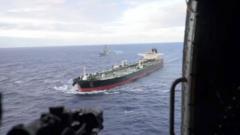
US boards tanker in Indian Ocean it 'tracked and hunted' from Caribbean
#Venezuela #Oil Tanker #Indian Ocean #US Coast Guard #Sanctions #Maritime Quarantine #Petroleum
📌 Key Takeaways
- US forces boarded an oil tanker in the Indian Ocean after a long-distance pursuit originating in the Caribbean.
- The operation was conducted to enforce a US-imposed quarantine on oil tankers departing from Venezuela.
- The vessel was 'tracked and hunted' over several weeks as it attempted to evade international sanctions.
- This high-seas intervention marks an escalation in the physical enforcement of US energy policy against the Venezuelan government.
📖 Full Retelling
The United States Coast Guard and naval personnel boarded a Venezuelan-linked oil tanker in the Indian Ocean on Thursday after tracking the vessel across thousands of miles from the Caribbean Sea to enforce a unilateral maritime quarantine. The high-seas operation was initiated because the tanker reportedly defied strict US-imposed sanctions and blockade measures designed to prevent the exportation of Venezuelan crude oil to international markets. US defense officials justified the boarding as a necessary measure to maintain the integrity of economic pressures aimed at the Venezuelan government, marking a significant escalation in the extraterritorial enforcement of American energy policies.
The vessel had been under intense surveillance by US intelligence and maritime patrol assets since it departed Southern Caribbean waters. According to Department of Defense sources, the ship—which was 'tracked and hunted' through multiple jurisdictions—attempted to bypass detection by utilizing various maritime evasion tactics, including the disabling of its automated identification system (AIS). The pursuit spanned several weeks and crossed through the Atlantic before the boarding took place in the remote waters of the Indian Ocean, demonstrating the expansive reach of US maritime enforcement capabilities.
Legal experts suggest that this operation reflects a more aggressive stance by the United States regarding the 'quarantine' of Venezuelan assets. Unlike traditional sanctions which often rely on port-state control or financial penalties, this direct physical intervention on the high seas signals a shift toward active interdiction. The US government maintains that such actions are vital for regional security and for ensuring that revenue from state-owned oil resources does not reach the current administration in Caracas, which Washington refuses to recognize as the legitimate leadership.
While the specific current location and destination of the ship remain classified for operational security, the incident has sparked international debate over the legality of enforcing domestic sanctions in international waters. US officials have indicated that the cargo will likely be seized or the vessel redirected, following a pattern of similar interceptions involving Iranian and Venezuelan energy shipments in recent years. The operation serves as a stark warning to international shipping companies and commodities traders involved in the transport of sanctioned Venezuelan petroleum.
🏷️ Themes
International Relations, Energy Sanctions, Maritime Security
Entity Intersection Graph
No entity connections available yet for this article.
Original Source
The US defended its actions, saying the ship defied a quarantine it has placed on oil tankers leaving Venezuela.
Read full article at source