
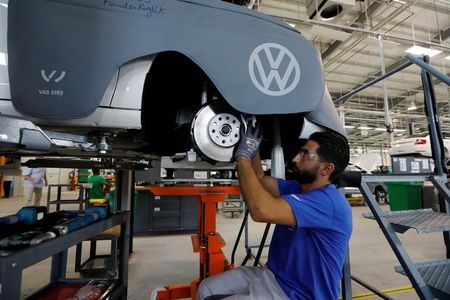
Volkswagen CEO defends 50,000 job cuts to offset high German production costs
#Volkswagen #job cuts #production costs #Germany #automotive industry #layoffs #competitiveness
📌 Key Takeaways
- Volkswagen CEO justifies 50,000 job cuts as necessary to reduce costs.
- High production costs in Germany are cited as the primary reason for the layoffs.
- The cuts aim to improve the company's competitiveness in the global market.
- The decision reflects broader challenges in the German automotive industry.
🏷️ Themes
Corporate Restructuring, Labor Market
📚 Related People & Topics

Volkswagen
German automobile manufacturer
Volkswagen (VW; German pronunciation: [ˈfɔlksˌvaːɡŋ̍] ) is a German automobile manufacturer based in Wolfsburg, Lower Saxony, Germany. Established in 1937 by the German Labour Front, it was revived after World War II by British Army officer Ivan Hirst and over the 81 years since grew into the global...

Germany
Country in Western and Central Europe
Germany, officially the Federal Republic of Germany, is a country in Western and Central Europe. It lies between the Baltic Sea and the North Sea to the north with the Alps to the south. Its sixteen constituent states have a total population of over 82 million, making it the most populous member sta...
Entity Intersection Graph
Connections for Volkswagen:
Mentioned Entities
Deep Analysis
Why It Matters
This news matters because Volkswagen's decision to cut 50,000 jobs represents one of the largest workforce reductions in recent European automotive history, directly impacting tens of thousands of German workers and their families. It highlights the severe competitive pressures facing Germany's manufacturing sector due to high labor costs, energy prices, and regulatory burdens compared to other regions. The move signals potential broader restructuring across Germany's industrial base as companies grapple with economic challenges, and could influence labor negotiations, government industrial policy, and investment decisions across Europe's largest economy.
Context & Background
- Volkswagen is Europe's largest automaker and Germany's biggest private employer, with approximately 675,000 employees worldwide as of 2023
- German manufacturing has faced increasing cost pressures with energy prices rising significantly since Russia's invasion of Ukraine in 2022
- The German automotive industry has been transitioning toward electric vehicles while facing intense competition from Chinese manufacturers and Tesla's more efficient production models
- Volkswagen previously announced a €10 billion cost-cutting program in 2023 to improve profitability amid declining market share in key markets
What Happens Next
Volkswagen will begin negotiations with labor unions in early 2025 regarding the implementation timeline and terms of the job reductions, with most cuts expected through attrition and early retirement programs rather than immediate layoffs. The company will likely accelerate shifting some production to lower-cost countries like Spain, Portugal, and Eastern Europe while investing in automation at remaining German facilities. German politicians may propose new industrial subsidies or labor market reforms in response, potentially leading to policy debates about Germany's economic competitiveness ahead of the 2025 federal election.
Frequently Asked Questions
Volkswagen is targeting German operations because production costs there are approximately 40% higher than at its plants in other European countries, driven by Germany's high wages, energy prices, and regulatory compliance expenses. The company needs to reduce these structural disadvantages to remain competitive against automakers producing in lower-cost regions.
Volkswagen claims the reductions won't significantly impact production volumes because they plan to increase automation and efficiency at remaining facilities. However, some specialized manufacturing may be relocated to other countries, potentially affecting Germany's automotive supply chain and technical expertise over time.
The cost savings from job cuts are intended to free up resources for Volkswagen's massive €180 billion investment in electrification and digitalization through 2027. However, labor unions worry reduced German workforce could slow EV development and production ramp-up at a critical time in the industry transition.
German labor laws and Volkswagen's strong union agreements require extensive consultation periods, generous severance packages, and preference for voluntary departures. Most reductions will occur through natural attrition, early retirement incentives, and retraining programs rather than forced layoffs.
Yes, BMW and Mercedes-Benz face similar cost pressures and may announce their own restructuring plans in 2025. However, their smaller scale and different production strategies might lead to less dramatic workforce reductions compared to Volkswagen's comprehensive restructuring.