
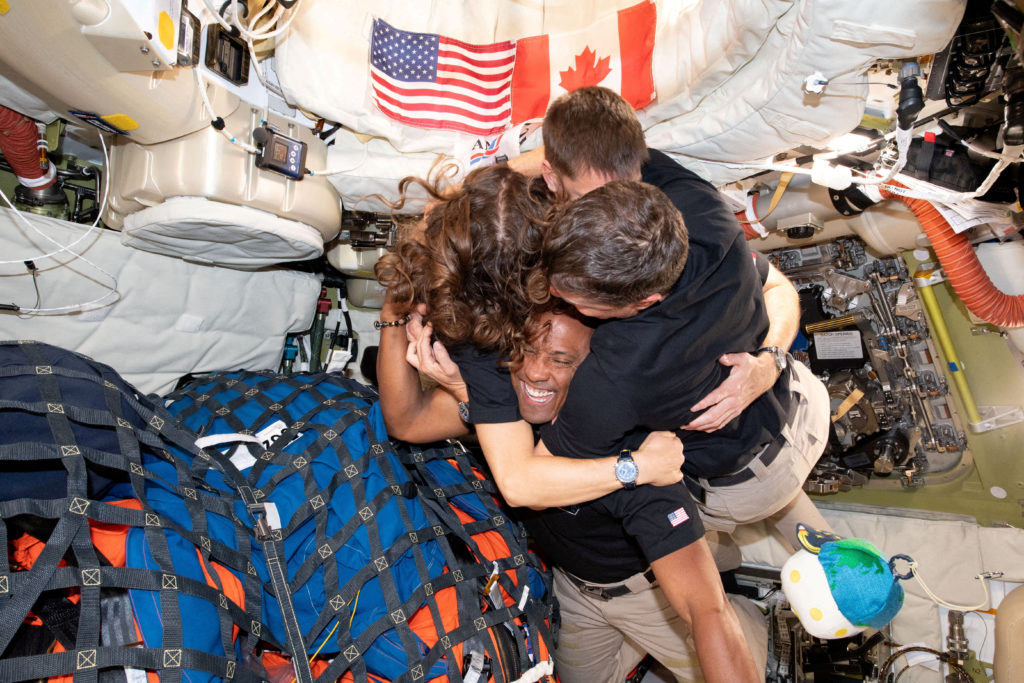
WATCH LIVE: Artemis II crew splashes down on Earth after historic trip around the moon
#Artemis II #NASA #Orion capsule #splashdown #Moon mission #astronauts #Pacific Ocean #re-entry
📌 Key Takeaways
- The four-person Artemis II crew safely splashed down in the Pacific Ocean after a mission around the Moon.
- The Orion capsule's re-entry was a high-risk phase, hitting the atmosphere at nearly 35,000 feet per second.
- The mission successfully tested critical spacecraft systems needed for future crewed lunar landings.
- The splashdown clears a major hurdle for NASA's Artemis III mission, which aims to land astronauts on the Moon.
📖 Full Retelling
🏷️ Themes
Space Exploration, NASA, Moon Mission
📚 Related People & Topics

NASA
American space and aeronautics agency
The National Aeronautics and Space Administration (NASA ) is an independent agency of the U.S. federal government responsible for the United States' civil space program and for research in aeronautics and space exploration. Headquartered in Washington, D.C., NASA operates ten field centers across th...

Artemis II
Artemis program's second lunar flight
Artemis II is a planned lunar spaceflight mission under the Artemis program, led by NASA. It is intended to be the second flight of the Space Launch System (SLS), and the first crewed mission of the Orion spacecraft. It is the first crewed mission around the Moon, and beyond low Earth orbit, since A...

Pacific Ocean
Largest ocean
The Pacific Ocean is the largest and deepest of Earth's five oceanic divisions. It stretches from the Arctic Ocean in the north to the Southern Ocean, or, depending on the definition, to Antarctica in the south, and is bounded by the continents of Asia and Australia in the west and the Americas in t...

Orion (spacecraft)
American crewed spacecraft for the Artemis program
Orion (Orion Multi-Purpose Crew Vehicle or Orion MPCV) is a partially reusable crewed spacecraft used in NASA's Artemis program. The spacecraft consists of a Crew Module (CM) space capsule designed by Lockheed Martin that is paired with a European Service Module (ESM) manufactured by Airbus Defence ...
Entity Intersection Graph
Connections for NASA:
Mentioned Entities
Deep Analysis
Why It Matters
This mission marks a pivotal milestone in returning humans to deep space, proving that the Orion spacecraft can safely transport astronauts through lunar re-entry. It validates the technology required for future lunar landings and establishes a foundation for a sustainable human presence on the Moon. Furthermore, the success of this mission builds the necessary confidence and momentum for NASA's long-term goal of sending crewed missions to Mars.
Context & Background
- The Artemis program is the successor to the Apollo program, which last sent humans to the Moon in 1972.
- Artemis I was an uncrewed test flight that successfully orbited the Moon and returned to Earth in late 2022.
- The Artemis II crew includes the first woman (Christina Koch) and the first person of color (Victor Glover) to fly on a lunar mission.
- The mission involves international partnership, notably with the Canadian Space Agency, which provided astronaut Jeremy Hansen.
- The long-term goal of Artemis is to establish a base on the Moon to test technologies for future missions to Mars.
What Happens Next
NASA will now analyze the data collected from the Orion spacecraft and the crew's health to finalize plans for the Artemis III mission. The focus will shift to the development and testing of the Starship Human Landing System (HLS) required for the actual lunar landing. Preparations for selecting the Artemis III crew and conducting surface operations training will intensify over the coming years.
Frequently Asked Questions
The crew consisted of NASA astronauts Reid Wiseman, Victor Glover, Christina Koch, and Canadian Space Agency astronaut Jeremy Hansen.
The main goal was to validate the Orion spacecraft's life support, navigation, and heat shield systems with a crew aboard during a lunar flyby.
The Orion capsule splashed down in the Pacific Ocean off the coast of San Diego.
The next major milestone is Artemis III, which aims to land the first woman and next man on the surface of the Moon.