
Why Conventional SETI Needs A Major Refocus
#SETI #Extraterrestrial intelligence #Broadband search #Electromagnetic spectrum #Ben Zuckerman #UCLA #Infrared astronomy #Galactic communication
📌 Key Takeaways
- Ben Zuckerman proposes shifting from narrowband to broadband SETI searches
- Current SETI focuses on a narrow 'galactic watering hole' between 1420-1662 MHz
- Existing astronomical surveys suggest few communicative civilizations exist within 650 light-years
- Infrared observations may be key to detecting extraterrestrial intelligence
📖 Full Retelling
🏷️ Themes
SETI strategy, Extraterrestrial intelligence, Scientific methodology
📚 Related People & Topics
Extraterrestrial intelligence
Hypothetical intelligent extraterrestrial life
Extraterrestrial intelligence (ETI) refers to hypothetical beings – extraterrestrial life or more artificial beings – having the intelligence to perform similar cognitive abilities as humans. No such life has ever been verifiably observed to exist. The question of whether other inhabited worlds migh...
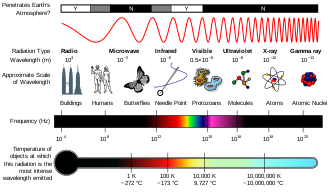
Electromagnetic spectrum
Range of frequencies or wavelengths of electromagnetic radiation
The electromagnetic spectrum is the full range of electromagnetic radiation, organized by frequency or wavelength. The spectrum is divided into separate bands, with different names for the electromagnetic waves within each band. From low to high frequency these are: radio waves, microwaves, infrared...

Search for extraterrestrial intelligence
Effort to find civilizations not from Earth
The search for extraterrestrial intelligence (usually shortened as SETI) is the diverse efforts and scientific projects intended to detect extraterrestrial signals, or any evidence of intelligent life beyond Earth. Researchers use methods such as monitoring electromagnetic radiation, searching for ...
Ben Zuckerman
Romanian-born American fashion designer
Ben Zuckerman (July 29, 1890 – August 9, 1979) was a Romanian-born, American fashion designer, known particularly for his high-quality tailored coats and suits. He made clothes for Jacqueline Kennedy while she was First Lady of the United States.
Entity Intersection Graph
No entity connections available yet for this article.
Mentioned Entities
Deep Analysis
Why It Matters
This news represents a significant paradigm shift in the search for extraterrestrial intelligence, potentially revolutionizing how humanity looks for advanced civilizations. If adopted, Zuckerman's approach could dramatically increase detection chances by expanding beyond traditional narrowband radio frequencies. This affects astronomers, space agencies, funding organizations, and the broader scientific community, as well as the general public interested in humanity's place in the cosmos.
Context & Background
- SETI began in earnest in 1960 with Project Ozma, led by astronomer Frank Drake, who searched for intelligent signals from nearby stars.
- The 'water hole' concept emerged in the 1970s, focusing on the 1420-1662 MHz range because these frequencies correspond to hydrogen (the most abundant element) and hydroxyl (which together form water).
- The SETI Institute was founded in 1984 to conduct and promote the search for extraterrestrial intelligence.
- In 2015, the Breakthrough Listen initiative was launched with $100 million in funding, conducting the most comprehensive SETI search to date.
- Despite decades of searching, no confirmed evidence of extraterrestrial intelligence has been found, leading to questions about the effectiveness of current search strategies.
- Recent exoplanet discoveries have revealed that potentially habitable worlds are common in our galaxy, with billions estimated to exist.
What Happens Next
Following Zuckerman's paper, we can expect increased debate within the SETI community about broadband versus narrowband searches. This could lead to new research proposals incorporating broader electromagnetic spectrum searches. Space agencies like NASA and ESA may begin planning infrared SETI missions, though these would likely take years to develop. Existing astronomical surveys may be re-examined through a SETI lens to look for potential technosignatures that were previously overlooked.
Frequently Asked Questions
SETI stands for Search for Extraterrestrial Intelligence, a scientific field dedicated to searching for evidence of advanced civilizations beyond Earth through various detection methods, primarily scanning the electromagnetic spectrum for potential signals.
SETI has traditionally focused on narrowband signals because they are more likely to be artificial (natural astrophysical processes typically produce broadband signals) and the 'water hole' frequencies were thought to be universally recognizable to any technological civilization.
Technosignatures are any signs of technology created by intelligent civilizations, which could include radio signals, optical laser communications, infrared waste heat, artificial structures, or other artifacts that would indicate intelligent activity.
Current estimates suggest there are billions of potentially habitable planets in our galaxy, with recent data from missions like Kepler and TESS indicating that Earth-sized planets in habitable zones are common around stars similar to our Sun.
Infrared SETI searches face challenges including atmospheric interference (requiring space-based observations), the need for highly sensitive instruments to detect potential signals, and the vastness of the infrared spectrum that would need to be searched.
Zuckerman's approach differs from conventional SETI by advocating for broadband searches across the entire electromagnetic spectrum rather than focusing on narrow frequency bands, and by leveraging existing astronomical survey data rather than conducting dedicated SETI observations.