
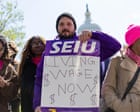
$30 an hour by 2030: new pushes to increase minimum wage in New York and California
📖 Full Retelling
📚 Related People & Topics

California
U.S. state
California () is a state in the Western United States that lies on the Pacific Coast. It borders Oregon to the north, Nevada and Arizona to the east, and shares an international border with the Mexican state of Baja California to the south. With almost 40 million residents across an area of 163,696 ...
Entity Intersection Graph
Connections for California:
Mentioned Entities
Deep Analysis
Why It Matters
This news matters because it represents a significant potential shift in wage policy that could affect millions of low-wage workers in two of America's largest economies. If implemented, these increases would substantially raise living standards for service, retail, and hospitality workers who have struggled with inflation and housing costs. The proposals could create ripple effects across other states and industries, potentially influencing national wage standards. However, businesses, particularly small enterprises, express concerns about increased operational costs that might lead to price hikes or reduced hiring.
Context & Background
- The current federal minimum wage has remained at $7.25 per hour since 2009, creating a growing gap with living costs
- Several states including California and New York already have minimum wages above $15/hour, with California at $16 and New York City at $16
- The Fight for $15 movement began in 2012 and successfully pushed many states and cities to adopt $15 minimum wages
- Inflation reached 40-year highs in 2022-2023, eroding purchasing power for minimum wage workers
- Previous research shows mixed economic impacts of minimum wage increases, with some studies showing job losses and others showing minimal employment effects
What Happens Next
Legislative debates will intensify in both states through 2024, with potential votes in 2025 legislative sessions. Business groups will likely lobby for exemptions or phased implementation schedules. If passed, the increases would be implemented gradually through 2030, with annual adjustments. Other progressive states like Washington, Massachusetts and Illinois may propose similar legislation in response. The outcomes could influence federal minimum wage debates ahead of the 2028 presidential election.
Frequently Asked Questions
In California alone, approximately 3-4 million workers currently earn less than $30/hour who would see raises. In New York, another 2-3 million workers would be affected, totaling potentially 6-7 million workers across both states receiving wage increases.
The $30 target represents nearly double California's current $16 minimum wage and would be approximately triple the federal minimum wage of $7.25. This would be the highest minimum wage in U.S. history when adjusted for inflation.
Opponents argue that rapid wage increases could lead to job losses, business closures, increased automation, and higher consumer prices. Small businesses in particular worry they cannot absorb such large labor cost increases without cutting staff or raising prices significantly.
Economists predict 'wage compression' effects where workers currently earning $30-35/hour might demand raises to maintain pay differentials. This could create upward pressure on wages across multiple industries and potentially increase inflation in service sectors.
No U.S. state has implemented a $30 minimum wage. The highest current state minimum is Washington's $16.28, though some cities like Seattle have higher rates. Internationally, Australia has minimum wages around $23 AUD ($15 USD) but with different economic conditions.