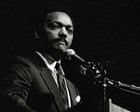
Jesse Jackson connected civil rights struggles with international liberation movements
His Palestinian rights advocacy was ahead of mainstream progressive thought
Jackson played a crucial role in securing sanctions against apartheid in South Africa
He achieved remarkable diplomatic successes in freeing Americans from hostile countries
📖 Full Retelling
US civil rights leader Jesse Jackson, who died at age 84 this week, left an indelible mark on global activism through his decades-long advocacy for human rights, opposition to apartheid in South Africa, support for Palestinian self-determination, and diplomatic missions to free American prisoners in countries considered hostile to the United States. Jackson's international influence extended far beyond American borders, as he consistently drew parallels between the African American struggle for civil rights and liberation movements worldwide. His 1988 push for Palestinian statehood in the Democratic party platform, though initially met with resistance, helped mainstream the cause within progressive circles. Jackson's willingness to meet with Palestinian Liberation Organization leader Yasser Arafat when the US government refused to engage directly demonstrated his commitment to direct diplomacy over isolation, a stance that sometimes put him at odds with mainstream political figures but ultimately proved influential in shifting perspectives on international human rights issues. In South Africa, Jackson emerged as a towering figure in the anti-apartheid movement, drawing massive crowds during his visits to Soweto in 1979 and becoming the most prominent presidential candidate to advocate for Nelson Mandela's release from prison. His diplomatic achievements included successfully negotiating the release of American prisoners from countries the US considered adversaries, including Syria, Cuba, Iraq, and Serbia, demonstrating his belief in cooperation as a tool for international problem-solving.
🏷️ Themes
Global Solidarity, Civil Rights Internationalism, Diplomacy and Advocacy
Rights preventing the infringement of personal freedom by other social actors
Civil and political rights are a class of rights that protect individuals' freedom from infringement by governments, social organizations, and private individuals. They ensure one's entitlement to participate in the civil and political life of society and the state.
Civil rights generally include en...
Apartheid ( ə-PART-(h)yte, especially South African English: ə-PART-(h)ayt, Afrikaans: [aˈpart(ɦ)əit] ; transl. "separateness", lit. 'aparthood') was a system of institutionalised racial segregation that existed in South Africa and South West Africa (now Namibia) from 1948 to the early 1990s. It wa...
Jesse Louis Jackson (né Burns; October 8, 1941 – February 17, 2026) was an American civil rights activist, politician, and ordained Baptist minister. Beginning as a young protégé of Martin Luther King Jr. during the civil rights movement, Jackson has maintained his status as a prominent civil rights...
‘A global hero’: Jesse’s Jackson’s legacy of activism around the world From opposing apartheid in South Africa to supporting Palestinian rights, the US civil rights leader left his mark across the globe W hen Jesse Jackson called for the Democratic party platform to include Palestinian statehood, the pushback was fierce. “While we had strong support from delegates at the convention, there was still a fear factor that the issue couldn’t be discussed ,” recalls James Zogby , who was deputy manager of Jackson’s presidential campaign. “I was told by the [nominee Michael] Dukakis negotiators, if you even say the P-word, you’ll destroy the Democratic party.” Jackson’s effort did not succeed at the 1988 Democratic National Convention in Atlanta. But 10 Democratic state parties had already passed resolutions in favour of Palestinian self-determination. And as the decades rolled by, more and more progressives came to share Jackson’s stance. Zogby, founder of the Arab American Institute, reflects: “He was way ahead of the base. Even the activists who supported Palestinians did not have the same depth of understanding .” When Jackson died on Tuesday at the age of 84, many tributes understandably focused on his contribution to the domestic civil rights struggle and how he bridged generations between Martin Luther King and Barack Obama. But perhaps uniquely for a non-president, his passing was also mourned around the world, from Havana to Johannesburg to Ramallah. Jackson was a man ahead of his time who blazed a trail for the progressives of today. He was a true internationalist, a trenchant critic of US imperialism and believer in the solidarity of oppressed people everywhere. He was an advocate of normalising relations with Cuba, a scourge of racial apartheid in South Africa and a prominent voice for Palestinian rights. He also embarked on missions to Syria, Iraq and Serbia to free US prisoners . Martha Biondi , a professor of Black studies and of history at Northwestern Unive...