
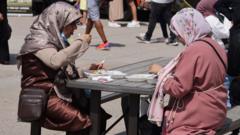
A secularism law some women say makes them feel like 'outsiders' heads to Canada's top court
#Quebec Bill 21 #Religious symbols #Supreme Court Canada #Laïcité #Muslim women #Notwithstanding clause #Secularism law #Religious discrimination
📌 Key Takeaways
- Canada's Supreme Court will hear a challenge to Quebec's Bill 21, which bans religious symbols for public sector workers
- Muslim women have been disproportionately affected by the law, with many feeling like outsiders and considering leaving Quebec
- The case also challenges the 'notwithstanding clause' in Canada's constitution that has shielded the law in lower courts
- The Quebec government seeks to expand the law to include all public school staff and daycare workers, and to ban prayer in public spaces
📖 Full Retelling
🏷️ Themes
Religious freedom, Secularism, Discrimination, Constitutional law
📚 Related People & Topics

Religious symbol
Icon representing a particular religion
A religious symbol is an iconic representation intended to represent a specific religion, or a specific concept within a given religion. Religious symbols have been used in the military in many countries, such as the United States military chaplain symbols. Similarly, the United States Department of...
Notwithstanding clause
Statutory provision overriding other laws
A notwithstanding clause (Lat: Non Obstante) is a provision in legislation that allows a law to operate despite certain other legal rules, rights, or principles that might otherwise conflict with it. Such clauses are used to assert legislative supremacy and to prevent courts from invalidating or lim...
Women in Islam
The experiences of Muslim women (Arabic: مسلمات Muslimāt, singular مسلمة Muslimah) vary widely between and within different societies due to culture and values that were often predating Islam's introduction to the respective regions of the world. At the same time, their adherence to Islam is a share...
Entity Intersection Graph
No entity connections available yet for this article.
Mentioned Entities
Deep Analysis
Why It Matters
This case addresses fundamental questions about religious freedom, secularism, and minority rights in Canada. It affects thousands of public sector workers, particularly Muslim women who wear hijabs, and could set a precedent for how religious expression is balanced against state secularism across Canada. The outcome will have significant implications for Canada's multicultural identity and the interpretation of constitutional rights.
Context & Background
- Quebec has a distinct history of promoting secularism and protecting French language and culture, dating back to the Quiet Revolution of the 1960s
- Bill 21, officially known as the 'An Act to foster adherence to State religious neutrality,' was passed in 2019 by Quebec's National Assembly
- The law invokes Canada's 'notwithstanding clause' (Section 33 of the Charter of Rights and Freedoms), which allows provinces to override certain constitutional rights for a five-year period
- Quebec previously had a policy banning religious symbols for certain public sector positions, but Bill 21 expanded this to include teachers, judges, police officers, and other public officials
- Similar debates about religious symbols have occurred in other countries, including France's ban on religious symbols in public schools and burqa bans in several European nations
What Happens Next
The Supreme Court hearing is scheduled for four days starting on Monday in Ottawa. After hearing arguments, the court will deliberate and issue a ruling at a later date, though no specific timeline was provided. If the court upholds Bill 21, it would reinforce the use of the notwithstanding clause and potentially embolden other provinces to pass similar laws. If struck down, it would limit how provinces can use the notwithstanding clause regarding religious expression and could lead to legislative changes in Quebec.
Frequently Asked Questions
Bill 21 is Quebec's secularism law passed in 2019 that prohibits public sector workers, including teachers, judges, and police officers, from wearing religious symbols while on the job.
The notwithstanding clause is Section 33 of Canada's Charter of Rights and Freedoms, which allows legislatures to override certain constitutional rights for a five-year period, renewable indefinitely.
The challengers include the Canadian Civil Liberties Association, the National Council of Canadian Muslims, the World Sikh Organization of Canada, and the English Montreal School Board, among others.
Research shows 73% of Muslim women in Quebec feel the law affects their ability to find work, a similar number have considered leaving the province, and over half report experiencing racist remarks or prejudice at work.
The decision could set a national precedent about religious freedom rights in Canada and affect how the notwithstanding clause can be used regarding religious expression, potentially influencing similar laws in other provinces.