
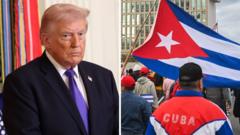
After Iran, will Trump turn his eyes to Cuba?
#Trump #Cuba #Iran #foreign policy #sanctions #diplomacy #administration
📌 Key Takeaways
- Trump administration may shift focus to Cuba after Iran actions.
- Potential policy changes could affect U.S.-Cuba relations.
- Speculation arises from Trump's previous hardline stance on Cuba.
- Timing and specifics of any Cuba moves remain uncertain.
📖 Full Retelling
🏷️ Themes
Foreign Policy, U.S.-Cuba Relations
📚 Related People & Topics

Cuba
Country in the Caribbean
Cuba, officially the Republic of Cuba, is an island country in the Caribbean. It comprises the eponymous main island as well as 4,195 islands, islets, and cays. Situated at the convergence of the Caribbean Sea, Gulf of Mexico, and Atlantic Ocean, Cuba is located east of the Yucatán Peninsula, south ...

Iran
Country in West Asia
# Iran **Iran**, officially the **Islamic Republic of Iran** and historically known as **Persia**, is a sovereign country situated in West Asia. It is a major regional power, ranking as the 17th-largest country in the world by both land area and population. Combining a rich historical legacy with a...

Donald Trump
President of the United States (2017–2021; since 2025)
Donald John Trump (born June 14, 1946) is an American politician, media personality, and businessman who is the 47th president of the United States. A member of the Republican Party, he served as the 45th president from 2017 to 2021. Born into a wealthy New York City family, Trump graduated from the...
Entity Intersection Graph
Connections for Cuba:
Mentioned Entities
Deep Analysis
Why It Matters
This news matters because it signals potential shifts in U.S. foreign policy that could affect millions of people. If President Trump redirects attention to Cuba after Iran, it could reverse the historic diplomatic thaw initiated under Obama, impacting Cuban citizens who benefited from eased travel and remittance restrictions. American businesses that invested in Cuba under normalized relations would face uncertainty, while Cuban-Americans with family ties to the island would see changes in visitation and support policies. The geopolitical implications extend to Russia and China's growing influence in Cuba, making this a strategic concern for U.S. national security interests in the Western Hemisphere.
Context & Background
- The U.S. embargo against Cuba began in 1960 under President Eisenhower and was strengthened under Kennedy after the failed Bay of Pigs invasion and Cuban Missile Crisis.
- President Obama initiated historic diplomatic normalization in 2014, reopening embassies, easing travel restrictions, and allowing limited business engagement after 54 years of hostility.
- President Trump partially reversed Obama's policies in 2017, tightening travel rules and prohibiting transactions with Cuban military-linked entities while maintaining diplomatic relations.
- Cuba remains one of only four countries designated by the U.S. as a State Sponsor of Terrorism (alongside Iran, North Korea, and Syria), a designation that carries significant sanctions.
- Russia has strengthened military and economic ties with Cuba in recent years, including debt relief and potential military facility access, challenging U.S. regional influence.
What Happens Next
The Trump administration may announce new Cuba sanctions or policy restrictions within the next 1-3 months, potentially before the November election. Key dates to watch include the annual UN vote on the Cuba embargo (typically October-November) and the deadline for reviewing Cuba's terrorism sponsor designation. Upcoming developments could include tightened travel restrictions, expanded sanctions targeting Cuban officials, or reduced diplomatic engagement. The administration may also pressure Latin American allies to take harder lines against Cuba's government.
Frequently Asked Questions
Trump could further restrict travel by eliminating categories of authorized travel to Cuba, reduce remittance limits Cuban-Americans can send to family, and expand the list of prohibited business transactions with Cuban entities. He might also consider closing the recently reopened U.S. embassy in Havana or redesignating Cuba as a 'state sponsor of terrorism' if it was previously removed.
Stricter U.S. policies would likely worsen Cuba's economic crisis by reducing remittances (a vital income source), limiting travel revenue, and restricting access to American goods. This could increase hardship for Cuban families already struggling with food shortages and economic contraction, potentially fueling greater migration attempts to the United States.
Cuba represents another longstanding adversary where Trump can demonstrate a tough foreign policy stance appealing to his political base, particularly in Florida where anti-Castro Cuban-Americans wield significant influence. The administration may view Cuba as an easier target than other foreign policy challenges, and increased Russian involvement in Cuba has raised new national security concerns.
Both countries have been designated as state sponsors of terrorism and represent longstanding adversaries where Trump has reversed Obama-era diplomatic openings. The administration's maximum pressure approach to Iran could serve as a model for Cuba policy, using economic sanctions and diplomatic isolation to pressure regime behavior change.
American companies in travel, telecommunications, agriculture, and manufacturing that entered the Cuban market under Obama-era openings would face new restrictions and uncertainty. Cruise lines, airlines, and hotel companies that established Cuba operations might need to scale back or exit, while agricultural exporters would lose one of their nearest foreign markets.
Congress could potentially block certain policy changes through legislation or funding restrictions, but the president has significant executive authority over embargo enforcement and travel regulations. While some Republicans and most Democrats support engagement with Cuba, Trump would likely veto any legislation preserving Obama-era policies, making congressional override unlikely.