
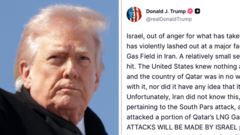
Are US and Israel aligned on Iran war? Deciphering Trump's post after gas field attacks
#US-Israel relations #Iran conflict #gas field attacks #Trump foreign policy #Middle East security
📌 Key Takeaways
- Trump's social media post suggests potential US-Israel alignment on Iran policy following gas field attacks.
- The attacks on gas fields are a key incident prompting analysis of international stances.
- Speculation arises about coordinated military or strategic responses against Iran.
- The article examines diplomatic signals and their implications for Middle East tensions.
🏷️ Themes
Geopolitics, Security
📚 Related People & Topics
Foreign policy of Donald Trump
Topics referred to by the same term
Foreign policy of Donald Trump may refer to:
List of wars involving Iran
This is a list of wars involving the Islamic Republic of Iran and its predecessor states. It is an unfinished historical overview.
Entity Intersection Graph
Connections for Foreign policy of Donald Trump:
View full profileMentioned Entities
Deep Analysis
Why It Matters
This news matters because it examines potential coordination between the US and Israel regarding military action against Iran, which could escalate regional tensions and trigger broader conflict. It affects Middle Eastern stability, global energy markets due to Iran's oil production, and international diplomatic relations. The analysis of Trump's statements provides insight into US foreign policy direction and alliance dynamics during a volatile period.
Context & Background
- The US and Iran have been in conflict since the 1979 Iranian Revolution and hostage crisis, with tensions escalating after the US withdrawal from the 2015 nuclear deal.
- Israel has viewed Iran as an existential threat due to Iran's nuclear program, support for militant groups like Hezbollah, and calls for Israel's destruction.
- The US has provided Israel with approximately $3.8 billion annually in military aid, creating a strong defense partnership.
- Iran has been accused of attacking oil tankers and infrastructure in the Gulf region, including previous attacks on Saudi oil facilities in 2019.
What Happens Next
Increased US sanctions pressure on Iran is likely, along with potential covert operations. Regional proxy conflicts may intensify in Syria, Iraq, and Yemen. Diplomatic efforts through European intermediaries could attempt to de-escalate tensions, while monitoring will continue for any direct military confrontations in the Persian Gulf.
Frequently Asked Questions
Trump's social media post suggested US awareness of the attacks and implied potential consequences for Iran, though it stopped short of explicitly threatening military action. The post was analyzed for coded language indicating US-Israel coordination.
Both countries share concerns about Iran's nuclear program and regional influence. Coordination allows for strategic alignment, intelligence sharing, and potentially synchronized pressure campaigns against Tehran.
Attacks on energy infrastructure in the Gulf region typically cause oil price volatility due to supply concerns. Any escalation could disrupt shipping through the Strait of Hormuz, through which 20% of global oil passes.
Iran would likely increase support for proxy forces in the region and potentially accelerate nuclear program development. Diplomatic channels with European nations might be used to counter US pressure.