
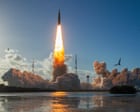
Artemis II astronauts prepare to leave Earth’s orbit and head towards the moon
📖 Full Retelling
📚 Related People & Topics

NASA
American space and aeronautics agency
The National Aeronautics and Space Administration (NASA ) is an independent agency of the U.S. federal government responsible for the United States' civil space program and for research in aeronautics and space exploration. Headquartered in Washington, D.C., NASA operates ten field centers across th...

Artemis II
Artemis program's second lunar flight
Artemis II is a planned lunar spaceflight mission under the Artemis program, led by NASA. It is intended to be the second flight of the Space Launch System (SLS), and the first crewed mission of the Orion spacecraft. It is the first crewed mission around the Moon, and beyond low Earth orbit, since A...
Entity Intersection Graph
Connections for NASA:
Mentioned Entities
Deep Analysis
Why It Matters
This mission represents humanity's first crewed lunar mission since Apollo 17 in 1972, marking a historic return to deep space exploration. It directly affects NASA's international partners, commercial space companies, and scientific communities who depend on lunar research. The success of Artemis II is crucial for establishing sustainable lunar presence and serves as a critical test for future Mars missions. This advancement also inspires STEM education globally and demonstrates renewed international cooperation in space exploration.
Context & Background
- The Artemis program is NASA's initiative to return humans to the Moon, named after Apollo's twin sister in Greek mythology
- Artemis I successfully completed an uncrewed test flight around the Moon in 2022, validating the Space Launch System rocket and Orion spacecraft
- The Apollo program (1961-1972) landed 12 astronauts on the Moon across six missions, with the last human lunar landing occurring 52 years ago
- Artemis II will be the first crewed mission of NASA's new lunar program and will test life support systems during a 10-day journey around the Moon
- The mission includes international participation through the Artemis Accords, with 40+ countries agreeing to peaceful lunar exploration principles
- This mission serves as a critical precursor to Artemis III, which aims to land astronauts near the lunar south pole in 2026
What Happens Next
Following successful completion of Artemis II (currently scheduled for September 2025), NASA will proceed with Artemis III - the program's first lunar landing mission targeting 2026. The Gateway lunar space station components will begin launching in late 2025 to support sustained lunar operations. International partners will contribute modules and technology for permanent lunar infrastructure. Commercial lunar landers from companies like SpaceX and Blue Origin will transport cargo and eventually crew to the lunar surface. Scientific instruments will be deployed to search for water ice and prepare for establishing a sustainable human presence.
Frequently Asked Questions
Artemis II uses modern technology including advanced computers, life support systems, and international cooperation through the Artemis Accords. Unlike Apollo missions that focused on short lunar visits, Artemis establishes infrastructure for sustained lunar presence and serves as a stepping stone to Mars. The mission also includes more diverse crew representation and collaboration with commercial space partners.
Primary objectives include testing Orion spacecraft systems with crew aboard, validating life support and communication systems during deep space travel, and ensuring crew safety during high-speed reentry to Earth. The mission will demonstrate operational procedures for future lunar missions and collect valuable data on human health and performance in deep space environments beyond low Earth orbit.
The four-person crew includes commander Reid Wiseman, pilot Victor Glover, mission specialist Christina Koch, and mission specialist Jeremy Hansen (first Canadian to orbit the Moon). They were selected for their extensive flight experience, technical expertise, and ability to represent NASA's commitment to diversity and international partnership. Their backgrounds include space station missions, engineering leadership, and scientific research qualifications.
Artemis II faces increased radiation exposure beyond Earth's protective magnetosphere, longer communication delays up to 30 seconds each way, and greater distance from emergency support. The mission requires perfect performance of new systems including the heat shield during high-speed reentry at 25,000 mph. Crew must be prepared for autonomous operations during periods when ground support is limited by distance.
Artemis II tests critical technologies needed for Mars missions including deep space navigation, radiation protection, and long-duration life support systems. The mission validates operational procedures for months-long journeys and provides data on human physiological responses to extended space travel. Lessons learned will directly inform spacecraft design and mission planning for eventual crewed Mars expeditions.
The mission will monitor crew health and performance in deep space radiation environments, test biological experiments in microgravity, and conduct Earth and lunar observations. Researchers will study effects of spaceflight on human physiology beyond low Earth orbit and test new medical monitoring equipment. The mission also serves as a technology demonstration platform for future lunar surface science instruments.