
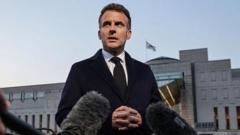
'Be serious... don't speak every day': Macron criticises Trump approach to Iran war
📖 Full Retelling
📚 Related People & Topics

Iran
Country in West Asia
# Iran **Iran**, officially the **Islamic Republic of Iran** and historically known as **Persia**, is a sovereign country situated in West Asia. It is a major regional power, ranking as the 17th-largest country in the world by both land area and population. Combining a rich historical legacy with a...

Donald Trump
President of the United States (2017–2021; since 2025)
Donald John Trump (born June 14, 1946) is an American politician, media personality, and businessman who is the 47th president of the United States. A member of the Republican Party, he served as the 45th president from 2017 to 2021. Born into a wealthy New York City family, Trump graduated from the...
Entity Intersection Graph
Connections for Iran:
Mentioned Entities
Deep Analysis
Why It Matters
This criticism matters because it highlights a significant rift in Western diplomatic strategy toward Iran, potentially undermining international efforts to prevent escalation in the Middle East. It affects global security by exposing divisions among key allies, which Iran could exploit to advance its nuclear or regional ambitions. The public disagreement also impacts diplomatic credibility, making coordinated responses to crises more difficult and increasing the risk of miscalculation.
Context & Background
- The U.S. withdrew from the Iran nuclear deal (JCPOA) in 2018 under Trump, reimposing sanctions and adopting a 'maximum pressure' campaign.
- France, along with other European powers, has sought to preserve the JCPOA and engage diplomatically with Iran to curb its nuclear program.
- Tensions have escalated recently with Iran enriching uranium to near-weapons-grade levels and supporting proxy groups in conflicts across the Middle East.
- Macron has previously positioned himself as a mediator in U.S.-Iran relations, advocating for dialogue over confrontation.
What Happens Next
Expect continued diplomatic friction between the U.S. and European allies ahead of potential future negotiations with Iran. If Trump returns to office, U.S. policy may shift further toward isolationism, prompting Europe to explore independent diplomatic channels. Regional instability could worsen if Iran perceives Western disunity as an opportunity to test redlines, possibly leading to renewed sanctions or covert actions.
Frequently Asked Questions
Macron believes Trump's frequent, unpredictable statements on Iran undermine serious diplomacy and increase the risk of miscalculation. He advocates for measured, private dialogue to de-escalate tensions and address Iran's nuclear program effectively.
The criticism reflects deeper disagreements over the deal's future, with Europe favoring its revival and Trump opposing it. This disunity weakens the West's leverage, making it harder to negotiate new terms or enforce compliance.
Public splits can embolden Iran to ignore international demands, seeing divided opposition. They also reduce trust in coordinated security measures, potentially leading to unilateral actions that escalate conflicts.
Yes, it may strain the alliance, especially if Trump returns to power, with France possibly aligning more with other European partners on Middle East policy. However, shared security interests in NATO may limit long-term damage.
Iran may use the disagreement to justify its hardline stance, arguing that the West is unreliable. It could also seek to exploit gaps by engaging separately with European diplomats while ignoring U.S. demands.