
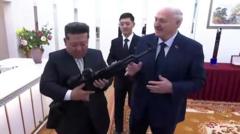
Belarus leader gifts rifle to North Korea's Kim as they sign friendship treaty
#Belarus #North Korea #Alexander Lukashenko #Kim Jong Un #friendship treaty #strategic partnership #military cooperation
📌 Key Takeaways
- Belarusian leader Alexander Lukashenko gifted a rifle to North Korean leader Kim Jong Un during a meeting.
- The two leaders signed a comprehensive strategic partnership treaty, strengthening bilateral ties.
- The agreement includes cooperation in political, economic, and military sectors between Belarus and North Korea.
- The meeting highlights growing diplomatic alignment between the two nations amid international isolation.
🏷️ Themes
Diplomacy, International Relations
📚 Related People & Topics

Alexander Lukashenko
President of Belarus since 1994
Alexander Grigoryevich Lukashenko (also transliterated from Belarusian as Alyaksandr Ryhoravich Lukashenka; born 30 August 1954) is a Belarusian politician who has been the first and only president of Belarus since the office's establishment in 1994, making him the current longest-serving European l...

Belarus
Country in Eastern Europe
Belarus, officially the Republic of Belarus, is a landlocked country in Eastern Europe. It is bordered by Russia to the east and northeast, Ukraine to the south, Poland to the west, and Lithuania and Latvia to the northwest. Belarus spans an area of 207,600 square kilometres (80,200 sq mi) with a po...

Kim Jong Un
Leader of North Korea since 2011
Kim Jong Un (born 8 January 1983 or 1984) is a North Korean politician who serves as both the general secretary of the Workers' Party of Korea (WPK) and the president of the State Affairs Commission. A member of the Kim family, he is the third supreme leader and dictator of North Korea, as well as t...

North Korea
Country in East Asia
North Korea, officially the Democratic People's Republic of Korea (DPRK), is a country in East Asia. It constitutes the northern half of the Korean Peninsula and borders China and Russia to the north at the Yalu (Amnok) and Tumen rivers, and South Korea to the south at the Korean Demilitarized Zone ...
Entity Intersection Graph
Connections for Alexander Lukashenko:
Mentioned Entities
Deep Analysis
Why It Matters
This news matters because it signals deepening military and political ties between two authoritarian states that are heavily sanctioned by the West, potentially altering regional security dynamics in Eastern Europe and Northeast Asia. It affects international relations by challenging U.S. and allied efforts to isolate these regimes, raising concerns about arms proliferation and shared authoritarian governance models. The treaty could facilitate technology transfers, including military and surveillance capabilities, impacting global non-proliferation efforts and diplomatic strategies.
Context & Background
- Belarus has been a key ally of Russia, supporting its invasion of Ukraine, and faces Western sanctions for human rights abuses under President Alexander Lukashenko.
- North Korea is under extensive international sanctions for its nuclear weapons program and has historically relied on partnerships with countries like China and Russia for support.
- The two nations have had diplomatic relations since 1992, but this treaty represents a significant upgrade, echoing Cold War-era alliances among Soviet-aligned states.
- Lukashenko previously visited North Korea in 1999, and recent interactions have increased amid shared isolation from Western powers.
What Happens Next
Expect increased diplomatic and military exchanges between Belarus and North Korea, with potential joint exercises or technology sharing in the coming months. The treaty may lead to Belarus providing military equipment to North Korea, possibly violating sanctions, which could trigger further international condemnation. Upcoming UN meetings or G7 summits will likely address this alliance, with possible new sanctions or diplomatic pressure from the U.S. and its allies by late 2024.
Frequently Asked Questions
The treaty likely includes mutual defense commitments, economic cooperation, and cultural exchanges, strengthening ties between the two sanctioned nations. It formalizes their alliance, potentially involving military support and shared resources to counter Western pressure.
The rifle symbolizes military solidarity and personal rapport, highlighting their shared authoritarian leadership styles. Such gifts are diplomatic gestures that reinforce trust and signal a focus on defense collaboration amid international isolation.
It could destabilize regions by enabling arms transfers and technology sharing, undermining non-proliferation efforts. The alliance may encourage other sanctioned states to form similar pacts, complicating international diplomacy and security frameworks.
The treaty may lead to tighter sanctions from Western nations, targeting any joint ventures or trade. However, it could also help both countries circumvent existing sanctions through bilateral cooperation, reducing their economic isolation.
Russia and China may see it as beneficial, strengthening an anti-Western bloc without direct involvement. However, they might also monitor it cautiously to avoid escalating tensions that could disrupt their own diplomatic balances.