
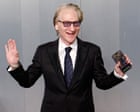
Bill Maher to receive Kennedy Center’s Mark Twain prize after White House denial
#Bill Maher #Kennedy Center #Mark Twain Prize #White House #humor #satire #cultural recognition
📌 Key Takeaways
- Bill Maher will receive the Kennedy Center's Mark Twain Prize for American Humor.
- The award follows a previous denial of the honor by the White House.
- The decision highlights recognition of Maher's contributions to comedy and satire.
- It underscores ongoing discussions about political influence on cultural awards.
📖 Full Retelling
🏷️ Themes
Awards, Politics
📚 Related People & Topics

Kennedy Center
National cultural center of the United States
The John F. Kennedy Center for the Performing Arts, commonly known as the Kennedy Center, is the national cultural center of the United States, serving as a "living memorial" to John F. Kennedy. Located on the eastern bank of the Potomac River in Washington, D.C., the center opened September 8, 1971...

Mark Twain Prize for American Humor
American award for the Performing Arts
The Mark Twain Prize for American Humor is an American award presented by the John F. Kennedy Center for the Performing Arts in Washington, D.C. annually since 1998 (except 2020–2021). Named after the 19th-century humorist Mark Twain, it is presented to individuals who have "had an impact on America...

White House
Residence and workplace of the US president
# The White House The **White House** is the official residence and principal workplace of the president of the United States. Located at **1600 Pennsylvania Avenue NW** in Washington, D.C., it stands as one of the most recognizable symbols of the American presidency and the United States governmen...
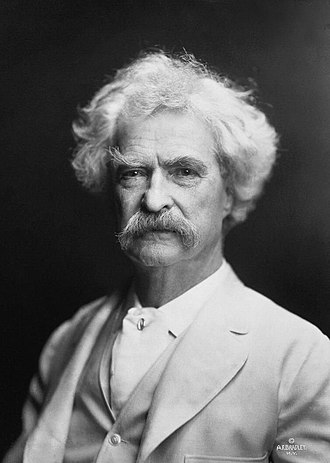
Mark Twain
American author and humorist (1835–1910)
Samuel Langhorne Clemens (November 30, 1835 – April 21, 1910), known by the pen name Mark Twain, was an American writer, humorist, and essayist. He has been praised as the "greatest humorist the United States has produced", with William Faulkner calling him "the father of American literature". Twain...

Bill Maher
American comedian and television host (born 1956)
William Maher (born January 20, 1956) is an American television host, comedian, actor and political commentator. Known for his political satire, he is the host of the HBO political talk show Real Time with Bill Maher (2003–present) and podcast Club Random (2022–present). He previously hosted late-ni...
Entity Intersection Graph
Connections for Kennedy Center:
Mentioned Entities
Deep Analysis
Why It Matters
This news matters because it highlights the intersection of political influence, cultural recognition, and freedom of expression. The White House's denial of Maher's award consideration reflects ongoing tensions between government institutions and outspoken media figures, potentially affecting how artistic merit is evaluated against political alignment. This affects Maher's career trajectory, the Kennedy Center's autonomy in award selection, and sets a precedent for how controversial public figures are recognized by official cultural institutions. The situation also raises questions about the separation between artistic achievement and political approval in government-affiliated honors.
Context & Background
- The Mark Twain Prize for American Humor has been awarded annually since 1998 by the Kennedy Center to recognize individuals who have influenced American society through humor.
- Bill Maher has hosted political talk shows 'Politically Incorrect' (1993-2002) and 'Real Time with Bill Maher' (2003-present), known for controversial commentary on religion, politics, and social issues.
- Previous recipients include Richard Pryor (1998), George Carlin (2008), Jon Stewart (2022), and Adam Sandler (2023), with the award sometimes generating controversy over recipient selection.
- The Kennedy Center operates as a federally-funded institution, receiving annual appropriations from Congress while maintaining artistic independence in programming decisions.
- The White House has historically maintained varying degrees of involvement with Kennedy Center honors, with presidents typically hosting recipients at the White House ceremony.
What Happens Next
Maher will receive the award at the Kennedy Center's ceremony, likely generating media coverage about the White House's non-involvement. The Kennedy Center may face questions about its selection process and relationship with government entities. Future award cycles may see increased scrutiny of potential recipients' political alignments, and there could be congressional discussions about the Kennedy Center's funding or autonomy if political tensions escalate around cultural recognition decisions.
Frequently Asked Questions
While the article doesn't specify exact reasons, Maher's history of controversial statements about religion and politics likely contributed to the White House's decision, reflecting concerns about political optics and alignment with administration values. Such denials typically involve assessments of how honoring a figure might affect government-public relations.
The Mark Twain Prize represents the highest recognition for humor in American culture, honoring individuals whose work reflects Twain's tradition of social commentary through satire. Recipients join a prestigious group of influential comedians and writers recognized for impacting American society through humor.
The Kennedy Center is a federally-funded performing arts center that receives congressional appropriations while operating as an independent nonprofit. This hybrid status creates tension between artistic independence and government oversight, particularly for awards and programming that may generate political controversy.
While not common, some Kennedy Center honorees have faced political controversy, though direct White House denial of consideration is unusual. Past recipients like Pete Seeger faced political scrutiny during Cold War-era ceremonies, but the institution has generally maintained award selection autonomy.
This situation raises questions about whether government-associated institutions should consider political factors in cultural recognition, potentially creating chilling effects on controversial artists. It highlights ongoing debates about where to draw lines between artistic merit assessment and political appropriateness in publicly-supported cultural institutions.