
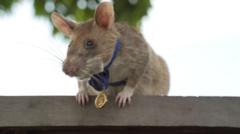
Cambodia unveils statue to honour famous landmine-sniffing rat
#Cambodia #landmine-sniffing rat #Magawa #APOPO #HeroRAT #humanitarian demining #PDSA Gold Medal #statue
📌 Key Takeaways
- Cambodia has unveiled a statue dedicated to a landmine-sniffing rat named Magawa.
- Magawa was a HeroRAT trained by the NGO APOPO to detect landmines and unexploded ordnance.
- He helped clear over 225,000 square meters of land, finding 71 landmines and 38 unexploded items.
- Magawa received the PDSA Gold Medal in 2020 for his lifesaving work and passed away in 2022.
- The statue honors his contributions to humanitarian demining efforts in Cambodia.
📖 Full Retelling
🏷️ Themes
Humanitarian Demining, Animal Heroes
📚 Related People & Topics

Magawa
Landmine-sniffing Tanzanian pouched rat (2013–2022)
Magawa (November 2013 – January 2022) was a Southern giant pouched rat (Cricetomys ansorgei) that worked as a HeroRAT sniffing out landmines in Cambodia for the non-governmental organization APOPO (in English, Anti-Personnel Landmines Removal Product Development) which trains rats to detect landmine...
PDSA Gold Medal
Bravery award to animals
The PDSA Gold Medal is an animal bravery award that acknowledges the bravery and devotion to duty of animals. It was created by the People's Dispensary for Sick Animals (PDSA) in 2001, and is now recognised as the animal equivalent of the George Cross. The Gold Medal is considered as the civilian eq...

APOPO
NGO that trains landmine- and tuberculosis-sniffing rats
APOPO (Dutch: Anti-Persoonsmijnen Ontmijnende Product Ontwikkeling, lit. 'Anti-Personnel Landmines Detection Product Development') is a registered Belgian non-governmental organisation and US non-profit which trains southern giant pouched rats and technical survey dogs to detect landmines and tuber...

Cambodia
Country in Southeast Asia
Cambodia, officially the Kingdom of Cambodia, is a country in Mainland Southeast Asia. It is bordered by Thailand to the northwest, Laos to the north, and Vietnam to the east, and has a coastline along the Gulf of Thailand in the southwest. It spans an area of 181,035 square kilometres (69,898 squar...
Entity Intersection Graph
No entity connections available yet for this article.
Mentioned Entities
Deep Analysis
Why It Matters
This news matters because it highlights Cambodia's ongoing struggle with landmines, a legacy of decades of conflict that continues to kill and maim civilians. It recognizes the innovative use of animals in humanitarian demining efforts, specifically African giant pouched rats trained to detect explosives safely. The statue symbolizes hope for mine-affected communities and honors the contributions of these animals to saving human lives and enabling land reuse.
Context & Background
- Cambodia is one of the world's most heavily landmine-contaminated countries, with an estimated 4-6 million landmines and unexploded ordnance remaining from conflicts including the Vietnam War and the Khmer Rouge era.
- Since 1979, landmines have caused over 64,000 casualties in Cambodia, with thousands of survivors living with disabilities and ongoing risks to farmers and children.
- The HeroRAT program, pioneered by the Belgian NGO APOPO, trains African giant pouched rats to detect landmines using their keen sense of smell; these rats are too light to trigger mines, making them safe and efficient detectors.
- Cambodia's demining efforts have been supported by international organizations and governments, with significant progress but ongoing challenges in rural and border areas.
What Happens Next
Cambodia aims to clear all landmines by 2025, with continued demining operations using rats, technology, and manual methods. The statue may become a site for educational tours or memorial events, raising awareness and funding for demining. APOPO and partners will likely expand rat-training programs in Cambodia and other affected countries like Angola and Zimbabwe.
Frequently Asked Questions
Rats are lightweight, avoiding mine detonation, and have an excellent sense of smell comparable to dogs. They are cheaper to train and maintain than machines, making them cost-effective for large-scale demining in developing countries.
HeroRATs can clear an area the size of a tennis court in 30 minutes, a task that might take a human with a metal detector four days. They have helped clear over 100,000 landmines globally, significantly speeding up demining efforts.
Retired rats are cared for in sanctuaries or adopted as pets, living out their natural lives. They receive veterinary care and are celebrated for their service, similar to military or working animals in other fields.
The statue raises public awareness about landmine issues, potentially increasing support and funding for demining projects. It honors the progress made and motivates continued efforts to achieve a mine-free Cambodia by 2025.