
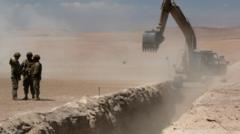
Chile's president begins building border barrier less than week into term
#Chile #border barrier #immigration #president #security #construction #policy
📌 Key Takeaways
- Chile's new president initiates border barrier construction within first week of term
- The project aims to enhance border security and control immigration flows
- This move signals a swift implementation of campaign promises on border policy
- The barrier's construction reflects ongoing regional debates on migration management
📖 Full Retelling
🏷️ Themes
Border Security, Immigration Policy
📚 Related People & Topics

Chile
Country in South America
Chile, officially the Republic of Chile, is a country in western South America. It is the southernmost country in the world and the closest to Antarctica, extending along a narrow strip of land between the Andes Mountains and the Pacific Ocean. According to the 2024 census, Chile had an enumerated p...
Entity Intersection Graph
Connections for Chile:
Mentioned Entities
Deep Analysis
Why It Matters
This rapid action by Chile's new president signals a major shift in border security policy that will immediately affect migration patterns and regional relations. The decision impacts thousands of migrants attempting to enter Chile, particularly from Venezuela, Peru, and Bolivia, while also affecting border communities and trade flows. This move demonstrates the administration's prioritization of immigration control as a central policy issue, which could influence political dynamics across South America where migration has become increasingly contentious.
Context & Background
- Chile has experienced significant immigration growth over the past decade, with the foreign-born population increasing from less than 2% in 2010 to over 8% in 2022
- The country has seen rising political tension around immigration, particularly following a 2021 incident where thousands of migrants crossed illegally from Bolivia
- Previous administrations implemented various immigration controls, but physical border barriers have been limited and controversial in Chile's history
- The new president campaigned on promises of stricter immigration controls and border security as part of his 'law and order' platform
What Happens Next
Construction will likely accelerate in coming weeks, potentially facing legal challenges from human rights groups and political opponents. The government will need to address diplomatic relations with neighboring countries affected by the barrier. Migration patterns may shift to other border points or countries, potentially creating new humanitarian challenges in the region by mid-2024.
Frequently Asked Questions
The new president is fulfilling campaign promises to address what he describes as an immigration crisis, responding to public concerns about security and social services. This represents a significant policy shift from previous administrations that had more open immigration approaches.
Initial construction is expected to focus on northern borders with Peru and Bolivia, which have seen the highest numbers of irregular crossings. These areas have become major migration routes for people from Venezuela and other countries seeking to enter Chile.
The barrier will likely force migrants to use more dangerous routes or seek asylum through official channels, potentially increasing risks and creating bottlenecks. It may also push migration flows toward other South American countries with less restrictive policies.
Neighboring countries have expressed concern about the barrier's impact on regional migration patterns and bilateral relations. Human rights organizations have criticized the move as violating international protection principles for migrants and refugees.
This represents a dramatic departure from Chile's traditionally more welcoming stance, particularly toward regional migrants. Previous governments emphasized integration programs rather than physical barriers as immigration solutions.