
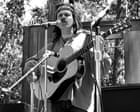
Country Joe McDonald, Woodstock star and anti-war singer, dies aged 84
#Country Joe McDonald #Woodstock #anti-war #singer #Vietnam War #counterculture #obituary
📌 Key Takeaways
- Country Joe McDonald, known for his performance at Woodstock, has died at age 84.
- He was a prominent anti-war singer and activist during the Vietnam War era.
- His song 'I-Feel-Like-I'm-Fixin'-to-Die Rag' became an anthem for the anti-war movement.
- McDonald's music and activism left a lasting impact on 1960s counterculture.
📖 Full Retelling
🏷️ Themes
Music, Activism
📚 Related People & Topics

Country Joe McDonald
American musician (born 1942)
Joseph Allen "Country Joe" McDonald (January 1, 1942 – March 7, 2026) was an American singer/songwriter, musician, film composer, and the lead singer and co-founder of the 1960s psychedelic folk-rock group Country Joe and the Fish. He wrote some of the group's most well-known songs, including "Not S...

Vietnam War
War in Southeast Asia from 1955 to 1975
The Vietnam War (1 November 1955 – 30 April 1975) was an armed conflict in Vietnam, Laos, and Cambodia fought between North Vietnam (Democratic Republic of Vietnam) and South Vietnam (Republic of Vietnam) and their allies. North Vietnam was supported by the Soviet Union and China, while South Vietna...

Woodstock
1969 music festival in Bethel, New York, US
The Woodstock Music and Art Fair, commonly referred to as Woodstock, was a music festival held from August 15 to 18, 1969, on Max Yasgur's dairy farm in Bethel, New York, 60 miles (95 km) southwest of the town of Woodstock. Billed as "an Aquarian Exposition: 3 Days of Peace & Music" and alternativel...
Entity Intersection Graph
Connections for Country Joe McDonald:
Mentioned Entities
Deep Analysis
Why It Matters
Country Joe McDonald's death marks the passing of a significant counterculture figure whose music defined the anti-war movement of the 1960s. His performance at Woodstock, particularly the 'Fish Cheer' and 'I-Feel-Like-I'm-Fixin'-to-Die Rag,' became iconic symbols of protest against the Vietnam War. This matters to music historians, veterans, peace activists, and the baby boomer generation who lived through that era, as it represents the loss of a voice that challenged political authority through art. His legacy continues to influence protest music and social activism today.
Context & Background
- Country Joe McDonald was the frontman of Country Joe and the Fish, a psychedelic rock band formed in 1965 that became central to the San Francisco music scene.
- The band's performance at the 1969 Woodstock Festival, where McDonald led the crowd in the infamous 'Fish Cheer' (spelling out F-I-S-H), became one of the event's most memorable moments.
- McDonald's 'I-Feel-Like-I'm-Fixin'-to-Die Rag' (1965) became an anthem of the anti-Vietnam War movement, using satire to criticize the war's futility and the draft.
- He remained politically active throughout his life, performing for veterans' groups and continuing to advocate for peace and social justice causes.
- Woodstock itself was a defining cultural event that symbolized the 1960s counterculture, drawing over 400,000 people to a dairy farm in New York in August 1969.
What Happens Next
Memorial tributes and retrospectives of McDonald's career are likely to emerge in music publications and documentaries. Fellow musicians from the Woodstock era may organize tribute concerts or releases. Historians will likely reassess his impact on protest music and the anti-war movement. His passing may renew interest in archival recordings and inspire new generations to explore the music of the 1960s counterculture.
Frequently Asked Questions
His most famous performance was at the 1969 Woodstock Festival, where he led the crowd in the 'Fish Cheer' and performed 'I-Feel-Like-I'm-Fixin'-to-Die Rag,' becoming an iconic moment of the event and the anti-war movement.
His satirical song 'I-Feel-Like-I'm-Fixin'-to-Die Rag' became an anthem for Vietnam War protesters, using humor and irony to criticize the war's senselessness and the draft, resonating with a generation seeking change.
The band was a pioneering force in the psychedelic rock movement, based in San Francisco, and helped define the sound and political ethos of the counterculture alongside groups like Jefferson Airplane and the Grateful Dead.
Yes, he continued to perform, record music, and advocate for veterans' rights and peace causes, maintaining his connection to the social justice movements he helped inspire in the 1960s.
Woodstock remains a symbol of 1960s counterculture, representing ideals of peace, music, and communal living, and its legacy continues to influence music festivals and social movements worldwide.