
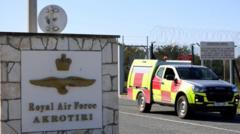
Cyprus leader calls for frank discussion on 'colonial' UK bases
#Cyprus #UK bases #colonial #military presence #diplomacy #sovereignty #negotiation
📌 Key Takeaways
- Cyprus's leader advocates for open dialogue on UK military bases in Cyprus.
- The bases are described as 'colonial' in nature, highlighting historical tensions.
- The call suggests a push for renegotiation or reassessment of the bases' status.
- This reflects ongoing diplomatic efforts regarding sovereignty and foreign military presence.
📖 Full Retelling
🏷️ Themes
International Relations, Colonial Legacy
📚 Related People & Topics

Cyprus
Island country in West Asia and the Mediterranean Sea
Cyprus, officially the Republic of Cyprus, is an island country in the eastern Mediterranean Sea, located off the coast of the Levant in West Asia. Cyprus’ capital and largest municipality is Nicosia. The northeast portion of the island is occupied by Turkey, which is separated from the Republic of ...
Entity Intersection Graph
Connections for Cyprus:
Mentioned Entities
Deep Analysis
Why It Matters
This news matters because it challenges the legitimacy of British military bases in Cyprus, which are among the UK's last remaining overseas territories with significant strategic military value. It directly affects UK-Cyprus diplomatic relations and could impact NATO's eastern Mediterranean security architecture. The call for discussion also resonates with broader post-colonial debates about foreign military presence on sovereign territory, potentially influencing similar situations globally.
Context & Background
- Cyprus gained independence from British rule in 1960 after 82 years of colonial administration
- The UK retained sovereignty over two military bases (Akrotiri and Dhekelia) covering 3% of Cyprus's territory under the 1960 Treaty of Establishment
- The bases have been used for operations in the Middle East, including recent strikes against Houthi targets in Yemen
- Cyprus has been divided since 1974 when Turkey invaded following a Greek-inspired coup, with the UK bases located in the Greek Cypriot-controlled south
What Happens Next
Expect formal diplomatic exchanges between Cyprus and the UK in the coming months, possibly at the UN General Assembly in September. The UK will likely emphasize the bases' NATO role and regional stability contributions. Cyprus may seek EU support for its position, potentially raising the issue in European Parliament discussions. No immediate changes to base status are expected, but pressure for revised agreements may grow.
Frequently Asked Questions
The UK maintains bases in Cyprus for strategic military positioning in the Eastern Mediterranean and Middle East. They serve as intelligence gathering stations and rapid deployment locations for operations in regions like the Levant and North Africa. The bases also support British sovereign territory obligations under the 1960 independence treaty.
The bases operate under the 1960 Treaty of Establishment that granted Cyprus independence. This treaty designated Akrotiri and Dhekelia as UK Sovereign Base Areas (SBAs). While Cyprus disputes their colonial nature, the UK considers them legitimate under international law and vital for regional security operations.
Views are mixed among Greek Cypriots, with some seeing them as colonial remnants and others valuing their economic contributions and security role. Turkish Cypriots generally accept them as stabilizing factors. Recent UK military actions launched from the bases have increased criticism from those opposing foreign military interventions in the region.
Cyprus cannot unilaterally remove the bases as they're established by treaty, but could pursue legal challenges or international pressure campaigns. Any change would require complex negotiations possibly involving compensation or phased withdrawal. The UK's strategic interests and NATO considerations make complete removal unlikely in the near term.
The bases employ approximately 3,000 Cypriots and contribute significantly to local economies through contracts and services. They also bring indirect benefits through infrastructure and security cooperation. However, critics argue Cyprus sacrifices sovereignty for these economic benefits and that the land could be better used for national development.