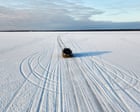
Drive the ‘ice road’, Estonians told – just don’t fasten your seatbelt
#Estonia #Ice road #Baltic Sea #Saaremaa #Hiiumaa #Winter travel #Arctic weather
📌 Key Takeaways
- A 20km ice road has opened between the Estonian islands of Saaremaa and Hiiumaa due to extreme cold.
- Drivers are strictly prohibited from wearing seatbelts to allow for a quick escape if the ice breaks.
- Specific speed limits are enforced to avoid creating resonant waves that could shatter the ice.
- The road serves as a shortcut across the frozen Baltic Sea, replacing the standard ferry routes.
📖 Full Retelling
🏷️ Themes
Transport, Environment, Safety
📚 Related People & Topics

Saaremaa
Largest island in Estonia
Saaremaa (; Estonian: [ˈsɑˑreˌmɑː]) is the largest and most populous island in Estonia. Measuring 2,673 km2 (1,032 sq mi), its population is 31,435 (as of January 2020). The main island of the West Estonian archipelago (Moonsund archipelago), it is located in the Baltic Sea, south of Hiiumaa island ...

Hiiumaa
Second largest island in Estonia
Hiiumaa (US: HEE-uum-ah, -ə-mah, Estonian: [ˈhiːumɑː]) is the second largest island in Estonia and is part of the West Estonian archipelago, in the Baltic Sea. It has an area of 989 km2 and is 22 km from the Estonian mainland. Its largest town is Kärdla.

Estonia
Country in Northern Europe
Estonia, officially the Republic of Estonia, is a country in the Baltic region of Northern Europe. It is bordered to the north by the Gulf of Finland across from Finland, to the west by the Baltic Sea across from Sweden, to the south by Latvia, and to the east by Russia. The territory of Estonia con...

Ice road
Path made over frozen water rather than land
An ice road or ice bridge is a human-made structure that runs on a frozen water surface (a river, a lake or a sea water expanse). Ice roads are typically part of a winter road, but they can also be simple stand-alone structures, connecting two shorelines. Ice roads may be planned, built and maintain...

Baltic Sea
Sea in northern Europe
The Baltic Sea is an arm of the Atlantic Ocean that is enclosed by the countries of Denmark, Estonia, Finland, Germany, Latvia, Lithuania, Poland, Russia, Sweden, and the North and Central European Plain regions. It is the world's largest brackish water basin. The sea stretches from 53°N to 66°N lat...
📄 Original Source Content
<p>Cold spell means cars can cross 20km stretch of frozen sea but drivers must be able to exit quickly in case of a problem</p><p>Temperatures in northern Europe have been so low that citizens of Estonia can now drive across a 20km stretch of frozen sea linking the country’s two main islands.</p><p>The so-called “ice road” connecting the islands of Saaremaa and Hiiumaa, located in western Estonia between the Baltic Sea and the Gulf of Riga, was officially opened on