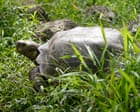
158 juvenile Floreana giant tortoises reintroduced after 180+ years of extinction
'Back breeding' program recreated subspecies using partial descendants from Wolf volcano
Invasive species eradication paved way for ecosystem recovery
Giant tortoises serve as keystone species critical for restoring Floreana's ecosystem
Future restoration plans target other endemic species
📖 Full Retelling
Conservationists and the Galápagos National Park Directorate have successfully reintroduced 158 juvenile Floreana giant tortoises to their native island habitat in the Galápagos archipelago in 2025, more than 180 years after the subspecies was driven to extinction by whalers who harvested them as food during hunting voyages. The Floreana giant tortoise (Chelonoidis niger niger), a distinctive subspecies once abundant across the volcanic island, faced complete elimination in the 1840s when whalers removed thousands to serve as a living larder during their extended voyages. Remarkably, a breakthrough came in 2008 when scientists discovered a relic population on Wolf volcano in Isabela Island that contained partial genetic ancestry from the Floreana subspecies. These tortoises had survived due to whalers occasionally depositing live tortoises on various islands and sometimes throwing them overboard when needing to lighten their vessels, creating an unexpected genetic reservoir that conservationists would later utilize. The ambitious 'back breeding' program initiated in 2017 involved selecting 23 hybrid tortoises with the closest genetic ties to the original Floreana subspecies to recreate the species as authentically as possible. Over eight years, this careful breeding effort produced more than 600 hatchlings, with several hundred growing to sufficient size for reintroduction. These magnificent creatures, which can reach nearly 1.5 meters in length as adults, represent not just a biological success but a significant milestone for the largest ecological restoration project ever undertaken in the Pacific Ocean archipelago.
🏷️ Themes
Conservation, Ecosystem Restoration, Species Recovery, Human Impact
Scientific study of renewing and restoring ecosystems
Ecological restoration, or ecosystem restoration, is the process of assisting the recovery of an ecosystem that has been degraded, damaged, destroyed or transformed. It is distinct from conservation in that it attempts to retroactively repair already damaged ecosystems rather than take preventative ...
The Floreana giant tortoise (Chelonoidis niger niger), also known as the Charles Island giant tortoise, is a subspecies of the Galápagos tortoise endemic to the Galápagos archipelago in the equatorial eastern Pacific Ocean. The specific epithet niger (‘black’) probably refers to the colouration of t...
Species reintroduction is the deliberate release of a species into the wild, from captivity or other areas where the organism is capable of survival. The goal of species reintroduction is to establish a healthy, genetically diverse, self-sustaining population to an area where it has been extirpated,...
Floreana giant tortoise reintroduced to Galápagos island after almost 200 years Subspecies driven to extinction by hungry whalers returns after ‘back breeding’ programme using partial descendants Giant tortoises, the life-giving engineers of remote small island ecosystems, are plodding over the Galápagos island of Floreana for the first time in more than 180 years. The Floreana giant tortoise ( Chelonoidis niger niger ), a subspecies of the giant tortoise once found across the Galápagos, was driven to extinction in the 1840s by whalers who removed thousands from the volcanic island to provide a living larder during their hunting voyages. Remarkably, 158 juvenile giant tortoises descended from the Floreana subspecies have been returned to the island in a vital step for the largest ecological restoration project undertaken on the Pacific Ocean archipelago. A relic population of giant tortoises discovered on Wolf volcano in the north of Isabela Island in 2008 were found to be descended in part from the Floreana population . Most of the Wolf volcano tortoises had domed shells like those living on Isabela’s other volcanoes to the south, but some had a saddleback-shaped carapace more typical of the tortoises that evolved on Floreana. A captive “back breeding” programme began in 2017, for which 23 hybrid tortoises most closely related to the Floreana subspecies were chosen to recreate it as genetically close to the original as possible. More than 600 hatchlings had been born by 2025, and several hundred grew large enough to be returned to their ancestral island. Males can reach nearly 1.5 metres (5ft) in length. Although whalers wiped out the Floreana tortoise, it ironically endured on Wolf volcano because they also deposited live tortoises on other islands for safekeeping and sometimes tossed tortoise cargo overboard if they needed to lighten their load during their whaling missions. Floreana, the sixth largest island in the archipelago, was once home to a wealth of endem...