
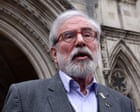
Former IRA bomber says Gerry Adams was senior figure in organisation
#IRA #Gerry Adams #former bomber #senior figure #Northern Ireland #conflict #denial #accountability
📌 Key Takeaways
- Former IRA bomber confirms Gerry Adams held a senior role in the IRA.
- The statement challenges Adams' long-standing denials of IRA membership.
- This revelation could impact historical narratives of the Northern Ireland conflict.
- It adds to ongoing debates about accountability and truth in post-conflict societies.
📖 Full Retelling
🏷️ Themes
Historical Accountability, Political Controversy
📚 Related People & Topics

Gerry Adams
Irish republican politician (born 1948)
Gerard Adams (Irish: Gearóid Mac Ádhaimh; born 6 October 1948) is an Irish republican retired politician who was the president of Sinn Féin from 1983 to 2018. He served as a Teachta Dála (TD) for Louth from 2011 to 2020 and as a Member of the Northern Ireland Legislative Assembly for Belfast West. F...

Northern Ireland
Part of the United Kingdom
Northern Ireland is a part of the United Kingdom in the north-east of the island of Ireland. It has been variously described as a country, province or region. Northern Ireland shares an open border to the south and west with the Republic of Ireland.
Entity Intersection Graph
Connections for Ira:
Mentioned Entities
Deep Analysis
Why It Matters
This revelation matters because it directly challenges Gerry Adams' long-standing public denials of IRA membership, potentially reopening historical wounds in Northern Ireland's peace process. It affects victims' families seeking truth and accountability, political parties in Northern Ireland and Ireland, and could impact Sinn Féin's current political standing. The timing is significant as Northern Ireland continues to navigate post-conflict reconciliation while political tensions remain.
Context & Background
- Gerry Adams served as President of Sinn Féin from 1983 to 2018 and has consistently denied being a member of the IRA despite widespread speculation
- The IRA (Irish Republican Army) conducted an armed campaign against British rule in Northern Ireland from 1969 until the 1998 Good Friday Agreement
- The Troubles in Northern Ireland resulted in approximately 3,500 deaths between 1968 and 1998
- Adams played a key public role in peace negotiations that led to the Good Friday Agreement and power-sharing government in Northern Ireland
What Happens Next
Political opponents will likely call for Adams to address the claims directly, while victims' groups may demand further investigation. The Public Prosecution Service could review whether the testimony warrants reopening any historical cases. Sinn Féin will need to manage the political fallout, particularly as they currently hold the First Minister position in Northern Ireland's power-sharing government.
Frequently Asked Questions
Adams maintained that as a political leader negotiating peace, he needed plausible deniability regarding paramilitary connections. Legal considerations also played a role, as admitting membership could have led to prosecution during the conflict.
Such testimony varies in reliability depending on the witness's motives, corroborating evidence, and timing. Historical statements about the Troubles often become contested, with accusations of political agendas on all sides.
Unlikely, given the passage of time and Northern Ireland's approach to legacy issues. The 1998 Good Friday Agreement included early release provisions for paramilitary prisoners, creating barriers to prosecuting pre-agreement offenses.
It could complicate Sinn Féin's efforts to present as a modern, progressive party in both Northern Ireland and the Republic of Ireland. However, their electoral base has shown resilience regarding historical controversies.
For some victims' families, it represents another frustrating chapter in seeking full disclosure about the Troubles. Others may view it as reopening old wounds without advancing genuine reconciliation or justice.