
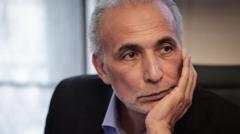
French court hands Islam scholar Tariq Ramadan 18-year jail term for rape
#Tariq Ramadan #rape conviction ##MeToo #Oxford professor #French court #multiple sclerosis #Muslim Brotherhood #sexual abuse
📌 Key Takeaways
- Tariq Ramadan sentenced to 18 years in prison for rape of three women in France
- Former Oxford scholar did not attend trial due to reported health issues in Switzerland
- This conviction follows a previous rape sentence in Switzerland
- One victim spoke of nine years of suffering since coming forward during Me Too movement
- Ramadan denies all charges and calls for new trial
📖 Full Retelling
🏷️ Themes
Sexual violence, Legal proceedings, #MeToo movement, Academic accountability
📚 Related People & Topics

Tariq Ramadan
Swiss Muslim scholar (born 1962)
Tariq Ramadan (Arabic: طارق رمضان [tˤaːriq ramadˤaːn]; born 26 August 1962) is a Swiss Muslim academic, philosopher, writer and convicted rapist. He has held academic positions including professor of contemporary Islamic studies at St Antony's College, Oxford and the Faculty of Theology and Religion...

French court
French Royal court
The French court ("Cour de France" in French), often simply "la cour", refers to the group of people, known as courtiers, who lived in the direct entourage of the king or, under the First and Second Empires, the emperor. In the Middle Ages, this courtly world included not only great lords but also r...

Muslim Brotherhood
Transnational Sunni Islamist organization
The Society of the Muslim Brothers (Arabic: جماعة الإخوان المسلمين, romanized: Jamāʿat al-Ikhwān al-Muslimīn), better known as the Muslim Brotherhood (الإخوان المسلمون, al-Ikhwān al-Muslimūn), is a transnational Sunni Islamist organization founded in Egypt by Islamic scholar, imam and schoolteacher ...
Entity Intersection Graph
No entity connections available yet for this article.
Mentioned Entities
Deep Analysis
Why It Matters
This case is significant as it involves a prominent intellectual and religious figure being convicted of serious sexual crimes. It affects the global Muslim community as Ramadan was an influential voice in Islamic thought. The verdict also comes during the #MeToo movement, highlighting how power dynamics can enable abuse even among respected figures. The case also raises questions about international legal cooperation when extradition treaties don't exist.
Context & Background
- Tariq Ramadan was a prominent Islamic scholar and professor at Oxford University, known for his moderate interpretations of Islam
- The #MeToo movement gained global momentum in 2017, encouraging victims of sexual assault to come forward
- Ramadan was first accused in 2018 by multiple women in France and Switzerland
- In 2020, Ramadan was convicted in Switzerland of raping a woman in 2008 and received a suspended sentence
- The French case specifically involved allegations from 2012 and 2009
- Ramadan has maintained his innocence throughout the legal proceedings
- Multiple sclerosis is a chronic illness that affects the central nervous system and can cause a variety of symptoms
What Happens Next
Ramadan will likely remain in Switzerland for medical treatment, though France has issued an arrest warrant. Without an extradition treaty, France may need to negotiate with Switzerland or wait for Ramadan to travel to a country with extradition arrangements. Ramadan may appeal the French verdict, which could extend the legal process. The case may also encourage more victims to come forward with similar allegations against other prominent figures.
Frequently Asked Questions
Tariq Ramadan is a prominent Islamic scholar and former professor at Oxford University who was known for his moderate interpretations of Islam and influence in Muslim communities worldwide.
Ramadan was convicted of raping three women - two in France (in 2012 and 2009) and one in Switzerland (in 2008). The French case originated when two women came forward during the #MeToo campaign in 2017.
Ramadan was absent from proceedings due to health issues in Geneva, where he is being treated for multiple sclerosis, a chronic illness affecting the central nervous system.
This is complicated by the fact that Switzerland and France lack an extradition treaty. France issued an arrest warrant, but enforcement would require diplomatic negotiations or Ramadan traveling to a country with extradition arrangements.
The French case originated when two women came forward during the #MeToo campaign in 2017, which encouraged victims of sexual assault to speak out against powerful figures. The verdict comes during a period when the #MeToo movement has brought numerous sexual abuse cases to court globally.
The judge emphasized that 'consenting to sex does not imply consenting to any sexual act whatsoever,' which clarifies that consent must be specific and ongoing throughout any sexual encounter, not a blanket permission for any sexual activity.