
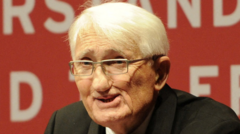
German philosopher and social critic Jürgen Habermas dies at 96
#Jürgen Habermas #German philosopher #social critic #critical theory #communicative rationality #public sphere #discourse ethics
📌 Key Takeaways
- Jürgen Habermas, a prominent German philosopher and social critic, has died at age 96.
- His death marks the loss of a major intellectual figure known for his work in critical theory and communicative rationality.
- Habermas was influential in shaping modern social and political thought, particularly through his theories on the public sphere and discourse ethics.
- His contributions spanned decades, impacting fields from philosophy and sociology to political science and communication studies.
📖 Full Retelling
🏷️ Themes
Philosophy, Intellectual Legacy
📚 Related People & Topics

German philosophy
Specialty in philosophy, focused on German language origin
German philosophy is philosophy in the German language or philosophy by German people. It is influential for both contemporary philosophical schools: the analytic and continental traditions. It covers figures such as Gottfried Wilhelm Leibniz, Immanuel Kant, Georg Wilhelm Friedrich Hegel, Karl Marx,...
Entity Intersection Graph
No entity connections available yet for this article.
Mentioned Entities
Deep Analysis
Why It Matters
Jürgen Habermas's death marks the end of an era for contemporary philosophy and social theory, as he was one of the most influential public intellectuals of the 20th and 21st centuries. His work on communicative action, deliberative democracy, and the public sphere fundamentally shaped debates in political philosophy, sociology, and legal theory. This loss affects academics, policymakers, and activists worldwide who engaged with his ideas about rational discourse and democratic legitimacy.
Context & Background
- Habermas was the last major surviving member of the Frankfurt School's second generation, continuing the Critical Theory tradition started by Max Horkheimer and Theodor Adorno.
- He developed his theory of communicative action in the 1980s, arguing that human rationality is rooted in language and the pursuit of mutual understanding.
- Habermas played a significant public role in post-war Germany, engaging in debates about German guilt, European integration, and the nature of democracy.
- His concept of the 'public sphere' from his 1962 work 'The Structural Transformation of the Public Sphere' became foundational for media studies and political communication research.
- Habermas remained intellectually active into his 90s, publishing on contemporary issues including digitalization, climate change, and European politics.
What Happens Next
Academic institutions worldwide will likely organize memorial conferences and special journal issues dedicated to Habermas's legacy. His extensive archive will become a crucial resource for scholars studying his work and intellectual development. Expect renewed debates about the relevance of his theories in addressing contemporary challenges like digital misinformation, political polarization, and global governance.
Frequently Asked Questions
Habermas's theory of communicative action revolutionized social theory by arguing that human rationality emerges through language-based interaction aimed at mutual understanding. His concept of deliberative democracy provided a normative framework for legitimate political decision-making through inclusive public discourse.
Habermas actively participated in German public debates about historical memory, European integration, and constitutional democracy. His interventions helped shape Germany's post-war political culture and influenced European Union debates about transnational democracy and human rights.
While sharing the Frankfurt School's critical approach, Habermas moved beyond their pessimism about modernity by developing a more constructive theory of rationality and democracy. Unlike earlier Critical Theorists who focused on domination, he emphasized the emancipatory potential of communicative reason.
His theories about the public sphere and deliberative democracy provide crucial frameworks for analyzing digital communication platforms and their impact on democratic discourse. His emphasis on rational argumentation offers tools for addressing contemporary challenges like political polarization and misinformation.
Habermas was a strong advocate for European integration based on constitutional patriotism and transnational democracy. He argued for a European public sphere and criticized technocratic approaches to EU governance, emphasizing instead the need for democratic legitimacy through citizen participation.