
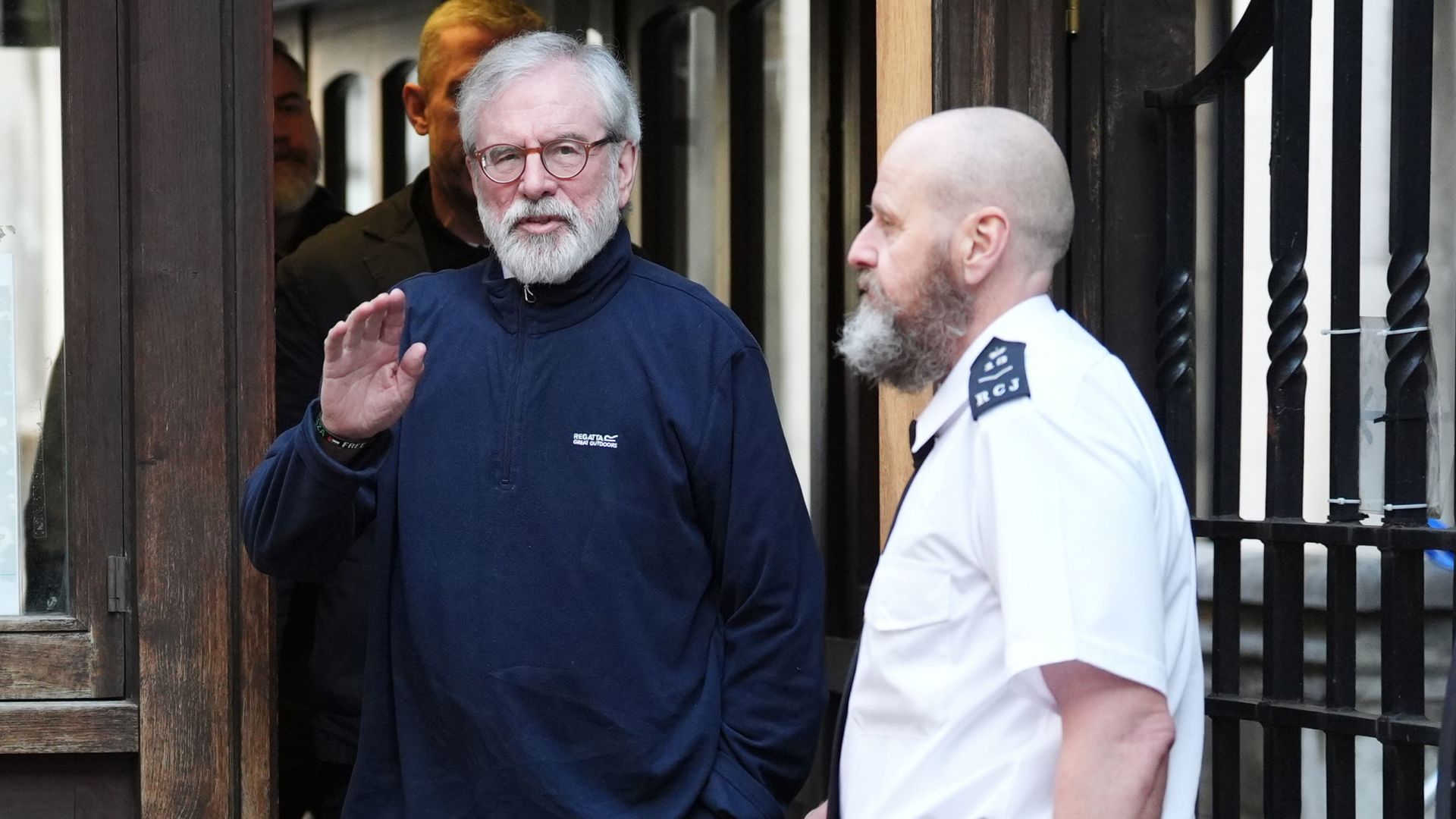
Gerry Adams at London trial to 'assert legitimacy of the republican cause'
#Gerry Adams #London trial #republican cause #legitimacy #Northern Ireland #political testimony #historical conflict
📌 Key Takeaways
- Gerry Adams appears at a London trial to defend the republican cause's legitimacy.
- The trial focuses on historical actions and political motivations of republicanism.
- Adams' testimony aims to contextualize past events within broader political struggles.
- The case highlights ongoing legal and political debates over Northern Ireland's conflict.
📖 Full Retelling
🏷️ Themes
Political Legitimacy, Historical Conflict
📚 Related People & Topics

Gerry Adams
Irish republican politician (born 1948)
Gerard Adams (Irish: Gearóid Mac Ádhaimh; born 6 October 1948) is an Irish republican retired politician who was the president of Sinn Féin from 1983 to 2018. He served as a Teachta Dála (TD) for Louth from 2011 to 2020 and as a Member of the Northern Ireland Legislative Assembly for Belfast West. F...

Northern Ireland
Part of the United Kingdom
Northern Ireland is a part of the United Kingdom in the north-east of the island of Ireland. It has been variously described as a country, province or region. Northern Ireland shares an open border to the south and west with the Republic of Ireland.
Entity Intersection Graph
Connections for Gerry Adams:
View full profileMentioned Entities
Deep Analysis
Why It Matters
This news matters because Gerry Adams' appearance at a London trial represents a significant moment in Northern Ireland's political evolution, where former paramilitary leaders engage with British legal institutions. It affects victims' families seeking justice, political parties in Northern Ireland assessing their historical narratives, and the British government managing delicate post-conflict relationships. The trial's proceedings could influence ongoing reconciliation efforts and potentially reshape how the Troubles are remembered and legally addressed.
Context & Background
- Gerry Adams was a key leader of Sinn Féin, the political wing of the Provisional IRA during the Northern Ireland conflict known as the Troubles (1968-1998).
- The Good Friday Agreement of 1998 established power-sharing in Northern Ireland and included provisions for prisoner releases and decommissioning of paramilitary weapons.
- Adams has consistently denied being a member of the IRA despite widespread allegations, and his political career transitioned from paramilitary leadership to elected office in both Northern Ireland and the Republic of Ireland.
What Happens Next
The trial will continue with witness testimonies and evidence presentation, potentially lasting several weeks. Following the verdict, there may be appeals or further legal actions depending on the outcome. Politically, the trial's conclusion could influence upcoming elections in Northern Ireland and impact ongoing discussions about legacy issues from the Troubles.
Frequently Asked Questions
While the article doesn't specify the exact case, Adams is likely appearing in relation to historical investigations into Troubles-era incidents, possibly involving allegations about IRA activities or events where British state forces were implicated.
By participating in a British court proceeding, Adams is demonstrating that republican politics has moved from armed struggle to engagement with state institutions. His presence frames historical republican actions as political rather than criminal, seeking recognition for their motivations within the conflict's context.
The trial could strain relationships within the power-sharing government, particularly between Sinn Féin and unionist parties. It may also influence public opinion about legacy issues and impact ongoing negotiations about how to address unresolved cases from the Troubles period.