
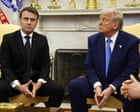
‘Get your own oil’: Trump launches tirade against Europe for not joining Iran war
📖 Full Retelling
📚 Related People & Topics

Iran
Country in West Asia
# Iran **Iran**, officially the **Islamic Republic of Iran** and historically known as **Persia**, is a sovereign country situated in West Asia. It is a major regional power, ranking as the 17th-largest country in the world by both land area and population. Combining a rich historical legacy with a...

Europe
Continent
Europe is a continent located entirely in the Northern Hemisphere and mostly in the Eastern Hemisphere. It is bordered by the Arctic Ocean to the north, the Atlantic Ocean to the west, the Mediterranean Sea to the south, and Asia to the east. Europe shares the landmass of Eurasia with Asia, and of A...

Donald Trump
President of the United States (2017–2021; since 2025)
Donald John Trump (born June 14, 1946) is an American politician, media personality, and businessman who is the 47th president of the United States. A member of the Republican Party, he served as the 45th president from 2017 to 2021. Born into a wealthy New York City family, Trump graduated from the...
Entity Intersection Graph
Connections for Iran:
Mentioned Entities
Deep Analysis
Why It Matters
This news matters because it reveals significant tensions in the NATO alliance and transatlantic relations at a critical geopolitical moment. It affects European leaders who must navigate strained relationships with the U.S. while maintaining their own security and energy interests. The comments also impact global oil markets and energy security discussions, particularly for European nations dependent on Middle Eastern oil. Additionally, it influences Iran's strategic calculations regarding regional conflicts and nuclear negotiations.
Context & Background
- The U.S. and Iran have been in conflict since the 1979 Iranian Revolution, with tensions escalating after Trump withdrew from the 2015 Iran nuclear deal in 2018.
- European nations have historically been more reluctant than the U.S. to engage militarily in the Middle East, with France and Germany opposing the 2003 Iraq invasion.
- NATO's Article 5 collective defense clause has been invoked only once—after the 9/11 attacks—highlighting the alliance's cautious approach to military engagements.
- Europe imports approximately 20% of its oil from the Middle East, making energy security a critical concern in regional conflicts.
- Trump previously criticized NATO members for not meeting defense spending targets, calling the alliance 'obsolete' before later reaffirming support.
What Happens Next
European foreign ministers will likely hold emergency meetings to coordinate their Iran policy and discuss responses to U.S. pressure. NATO may issue statements reaffirming alliance unity while acknowledging policy differences. Iran will probably intensify diplomatic outreach to European capitals to exploit transatlantic divisions. The U.S. may increase sanctions pressure on European companies doing business with Iran. Upcoming NATO summits in 2024 will feature tense discussions about burden-sharing and Middle East policy.
Frequently Asked Questions
European countries prioritize diplomatic solutions to maintain regional stability and protect their economic interests, including the Iran nuclear deal. They also face domestic political opposition to Middle Eastern military engagements after costly interventions in Afghanistan and Iraq.
Trump's comments increase uncertainty about Middle Eastern oil supplies, potentially causing price volatility. European nations may accelerate diversification efforts toward renewable energy and non-Middle Eastern suppliers like Norway and the U.S.
European nations would require UN Security Council authorization or invoke self-defense principles under international law. NATO's collective defense clause (Article 5) only applies to attacks on member territories, not overseas conflicts.
European mediation efforts become more difficult as Iran questions Europe's ability to deliver sanctions relief. However, Europe may try to preserve diplomatic channels separately from U.S. policy to prevent complete collapse of the agreement.
Similar divisions occurred during the 2003 Iraq War when France and Germany opposed U.S. invasion plans. The 1956 Suez Crisis also saw the U.S. opposing European military action against Egypt, straining alliances temporarily.