
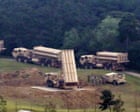
Hasty redeployment of US missiles from South Korea to Middle East leaves Seoul rattled
#US missiles #South Korea #Middle East #redeployment #Seoul #defense #alliance
📌 Key Takeaways
- The US has redeployed missile systems from South Korea to the Middle East, a move described as hasty.
- This redeployment has caused concern and unease in Seoul, South Korea.
- The action reflects shifting US military priorities towards the Middle East region.
- The move potentially impacts South Korea's defense posture and US-South Korea alliance dynamics.
📖 Full Retelling
🏷️ Themes
Military Strategy, Alliance Relations
📚 Related People & Topics

Seoul
Capital and largest city of South Korea
Seoul, officially Seoul Special Metropolitan City, is the capital and largest city of South Korea, and the largest city in the whole of Korea. The broader Seoul Metropolitan Area, encompassing Seoul, Gyeonggi Province and Incheon, emerged as the world's sixth largest metropolitan economy in 2022, be...

Middle East
Transcontinental geopolitical region
The Middle East is a geopolitical region encompassing the Arabian Peninsula, Egypt, Iran, Iraq, the Levant, and Turkey. The term came into widespread usage by Western European nations in the early 20th century as a replacement of the term Near East (both were in contrast to the Far East). The term ...

South Korea
Country in East Asia
South Korea, officially the Republic of Korea (ROK), is a country in East Asia. It constitutes the southern half of the Korean Peninsula and borders North Korea along the Korean Demilitarized Zone, with the Yellow Sea to the west and the Sea of Japan to the east. South Korea claims to be the sole le...
Entity Intersection Graph
Connections for Seoul:
View full profileMentioned Entities
Deep Analysis
Why It Matters
This news is important because it reveals shifting U.S. military priorities that directly impact South Korea's security posture, potentially weakening its defense against North Korean missile threats. It affects South Korean policymakers, military officials, and citizens who rely on U.S. extended deterrence, as well as U.S. strategic planners balancing commitments in Asia and the Middle East. The move could strain the U.S.-South Korea alliance, raising questions about Washington's long-term reliability in regional security.
Context & Background
- The U.S. has maintained a significant military presence in South Korea since the Korean War armistice in 1953, with troops and advanced weaponry to deter North Korea.
- North Korea has accelerated its missile testing in recent years, including intercontinental ballistic missiles (ICBMs) capable of reaching the U.S. mainland.
- The U.S. and South Korea regularly conduct joint military exercises and have deployed Terminal High Altitude Area Defense (THAAD) systems in South Korea, despite regional objections.
- The Middle East has seen escalating tensions, including conflicts involving Iran, Israel, and militant groups, requiring U.S. military resources.
What Happens Next
South Korea may seek urgent consultations with U.S. officials to clarify the timeline for missile replacement and reassess its own defense capabilities. The U.S. might face pressure to expedite alternative deployments or provide compensatory security assurances to Seoul. In the longer term, this could accelerate South Korea's discussions on enhancing its independent missile defense systems or reconsidering military partnerships.
Frequently Asked Questions
The U.S. likely faces urgent security needs in the Middle East, such as countering threats from Iran or militant groups, requiring immediate missile assets. This reflects global military resource constraints and prioritization of emerging crises over longstanding commitments.
It temporarily reduces South Korea's missile defense capacity, potentially increasing vulnerability to North Korean provocations. South Korea may need to rely more on its own military assets or seek temporary support from other U.S. allies in the region.
Yes, this incident may accelerate South Korea's efforts to bolster its indigenous missile defense systems and reduce dependency on U.S. deployments. It could also spur debates in Seoul about greater military self-reliance and strategic autonomy.
The U.S. has occasionally shifted military assets between regions during crises, such as moving naval forces during the Gulf War or after 9/11. However, rapid withdrawals from key allies like South Korea are rare and politically sensitive.