
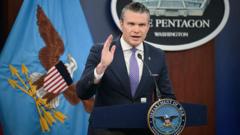
Hegseth calls on US allies to 'step up' over Strait of Hormuz
📖 Full Retelling
📚 Related People & Topics

Pete Hegseth
American government official and television personality (born 1980)
Peter Brian Hegseth (born June 6, 1980) is an American government official and former television personality who has served as the 29th United States secretary of defense since 2025. Hegseth studied politics at Princeton University, where he was the publisher of The Princeton Tory, a conservative st...

Strait of Hormuz
Strait between the Gulf of Oman and the Persian Gulf
The Strait of Hormuz ( Persian: تنگهٔ هُرمُز Tangeh-ye Hormoz , Arabic: مَضيق هُرمُز Maḍīq Hurmuz) is a strait between the Persian Gulf and the Gulf of Oman. It provides the only sea passage from the Persian Gulf to the open ocean and is one of the world's most strategically important choke points. ...
Entity Intersection Graph
Connections for Pete Hegseth:
Mentioned Entities
Deep Analysis
Why It Matters
This statement matters because the Strait of Hormuz is one of the world's most critical maritime chokepoints, through which about 20-30% of global oil trade passes. Hegseth's call reflects growing U.S. pressure on allies to share more of the security burden in volatile regions, affecting global energy markets and international relations. It impacts U.S. allies in Europe and Asia who depend on Middle Eastern oil, regional powers like Iran that border the strait, and global shipping companies. The demand for allied 'stepping up' could signal a shift in U.S. foreign policy toward more burden-sharing in maintaining global trade routes.
Context & Background
- The Strait of Hormuz is a narrow waterway between Oman and Iran, connecting the Persian Gulf with the Gulf of Oman and Arabian Sea.
- Approximately one-fifth of the world's petroleum liquids and one-third of global LNG trade passes through this strait daily.
- The U.S. Fifth Fleet, based in Bahrain, has historically led naval patrols to ensure freedom of navigation in the region.
- Tensions have periodically escalated in the strait, including tanker attacks and seizures by Iran in recent years.
- The U.S. has maintained a military presence in the region since the 1980s 'Tanker War' during the Iran-Iraq conflict.
What Happens Next
Allied nations may face increased diplomatic pressure to contribute more naval assets to patrols in the coming months. The U.S. could organize multilateral naval exercises or propose new security frameworks for the strait. If allies don't 'step up' sufficiently, the U.S. might reconsider its own commitment level, potentially creating security gaps. Regional tensions could escalate if Iran perceives reduced U.S. presence as an opportunity to assert more control over the waterway.
Frequently Asked Questions
While the article doesn't specify, Hegseth is likely a U.S. official or commentator advocating for foreign policy positions. His call reflects broader debates about burden-sharing in international security and signals potential policy shifts regarding U.S. military commitments in strategic regions.
The strait is crucial because it's the only sea passage from the Persian Gulf to open oceans, making it essential for oil exports from Saudi Arabia, Iraq, UAE, Kuwait, Qatar, and Iran. Any disruption would immediately impact global oil prices and energy security worldwide.
Major oil importers like China, Japan, India, and European nations are most affected since they rely heavily on Middle Eastern oil shipments. Regional countries including Iran, Oman, UAE, and Saudi Arabia have direct security interests, while the U.S. as global naval power bears disproportionate security costs.
It likely means contributing more naval vessels, personnel, and funding to patrol the strait, sharing intelligence, participating in joint exercises, and potentially taking more operational responsibility. This could involve European, Asian, and Middle Eastern allies increasing their maritime presence.
Iran has periodically threatened to close the strait during tensions, conducted military exercises nearby, and occasionally seized foreign tankers. Tehran views the waterway as within its sphere of influence and opposes what it considers excessive Western military presence.
Reduced patrols could embolden Iran to test navigation freedoms, increase piracy risks, and create security vacuums that non-state actors might exploit. This could lead to insurance rate hikes for shipping, supply disruptions, and potential military confrontations if incidents occur.