
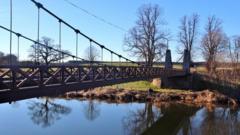
Historic Borders bridge secures £250,000 for restoration project
#Kalemouth Suspension Bridge #Scottish Borders #National Lottery Heritage Fund #Historic Restoration #River Teviot #Pedestrian Access #Capt Samuel Brown
📌 Key Takeaways
- Historic Kalemouth Suspension Bridge secured £250,000 for restoration
- Built around 1835 by Capt Samuel Brown, bridge was closed to vehicles in 2020 due to decay
- Restoration will focus on replacing timber work, deck bracing, and refurbishing ironwork and masonry
- Council previously ruled out spending £4m to allow cars again due to cost concerns
- Bridge will be maintained as a crossing for cyclists and pedestrians only
📖 Full Retelling
🏷️ Themes
Heritage Preservation, Infrastructure Restoration, Transportation Alternatives
📚 Related People & Topics

Kalemouth Suspension Bridge
Bridge
The Kalemouth Suspension Bridge is a suspension bridge at Kalemouth in the Scottish Borders area of Scotland, near the B6401. It crosses the River Teviot just above its confluence with the Kale Water, near Eckford.

River Teviot
River in Scottish Borders, Scotland
The River Teviot (; Scottish Gaelic: Abhainn Tìbhiot), or Teviot Water, is a river of the Scottish Borders area of Scotland, and is the largest tributary of the River Tweed by catchment area. The Teviot is an important river for wildlife, especially the Atlantic salmon, but in recent years has witne...
National Lottery Heritage Fund
Fund distributing money raised by the UK National Lottery
The National Lottery Heritage Fund, formerly the Heritage Lottery Fund (HLF), distributes a share of National Lottery funding, supporting a wide range of heritage projects across the United Kingdom.

Scottish Borders
Council area of Scotland
The Scottish Borders (Scottish Gaelic: Crìochan na h-Alba; Scots: The Mairches), often shortened to the Borders within Scotland, is one of the country's 32 council areas. It is bordered by West Lothian, Edinburgh, Midlothian, and East Lothian to the north, the North Sea to the east, Dumfries and Gal...
Entity Intersection Graph
No entity connections available yet for this article.
Mentioned Entities
Deep Analysis
Why It Matters
This funding is significant for preserving a 200-year-old piece of engineering heritage that serves as both a functional crossing and a historical landmark. The restoration will ensure the bridge's continued use by pedestrians and cyclists while maintaining its historical value for future generations. This project represents a commitment to sustainable transportation alternatives and cultural preservation in the Scottish Borders region.
Context & Background
- The Kalemouth Suspension Bridge was constructed around 1835 by Captain Samuel Brown, who was also responsible for building the Union Chain Bridge that links Scotland and England.
- The bridge is approximately 200 years old and has been carrying traffic across the River Teviot near Eckford for nearly two centuries.
- It was previously listed as Category A, indicating it's of national importance in terms of architectural or historical significance.
- The bridge was closed to vehicles in August 2020 after engineers determined it was no longer structurally sound due to substantial decay in its timber deck.
- Before closure, it carried single-file traffic weighing less than three tonnes between the A698 and properties in Ormiston Mains.
- Scottish Borders Council had previously ruled out spending £4 million to restore vehicle access, determining the expense could not be justified.
What Happens Next
With the £250,000 secured from the National Lottery Heritage Fund, the Scottish Borders Council can now proceed with detailed planning for the restoration project. The next steps likely include finalizing additional funding sources, completing detailed engineering plans, and beginning the physical restoration work focused on replacing timber work and deck bracing, as well as refurbishing the ironwork and masonry. The project timeline would need to be established, with potential completion dates likely in the next 1-2 years depending on funding and planning processes.
Frequently Asked Questions
The bridge was closed in August 2020 due to substantial decay in its timber deck, making it no longer structurally safe for vehicle traffic.
The bridge is approximately 200 years old, built around 1835 by Captain Samuel Brown, who also constructed the Union Chain Bridge linking Scotland and England.
No, the restoration project is specifically designed to make the bridge safe for cyclists and pedestrians only, not vehicles.
The project will focus on replacing the timber work and deck bracing, as well as refurbishing the ironwork and masonry to ensure safe pedestrian and cyclist use.
The project will include new interpretation panels to share the story and significance of the bridge, ensuring its historical value is appreciated by future generations.