
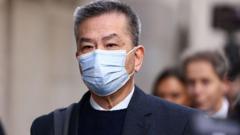
Hong Kong government employee denies ordering surveillance of UK dissidents
📚 Related People & Topics

Hong Kong
Special administrative region of China
Hong Kong is a special administrative region of China. Situated on China's southern coast just south of Shenzhen, it consists of Hong Kong Island, Kowloon, and the New Territories. With 7.5 million residents in a 1,114-square-kilometre (430 sq mi) territory, Hong Kong is the fourth-most densely popu...

United Kingdom
Country in northwestern Europe
The United Kingdom of Great Britain and Northern Ireland, commonly known as the United Kingdom (UK) or Britain, is a country in northwestern Europe, off the coast of the continental mainland. It comprises England, Scotland, Wales and Northern Ireland, with a population of over 69 million in 2024. Th...
Entity Intersection Graph
Connections for Hong Kong:
Mentioned Entities
Deep Analysis
Why It Matters
This news matters because it involves allegations of extraterritorial surveillance by Hong Kong authorities against dissidents in the UK, raising serious concerns about the reach of Hong Kong's security apparatus beyond its borders. It affects UK-based Hong Kong activists who fear for their safety, UK-China diplomatic relations which are already strained, and Hong Kong's international reputation as it faces accusations of violating other nations' sovereignty. The denial by a Hong Kong official highlights the sensitive nature of cross-border security operations and the potential for diplomatic fallout between China and Western nations.
Context & Background
- Hong Kong's National Security Law was implemented in 2020, granting authorities broad powers to pursue acts deemed as secession, subversion, terrorism, or collusion with foreign forces.
- Since the 2019 protests, many Hong Kong activists have relocated abroad, particularly to the UK, Canada, and Australia, where they continue to criticize Hong Kong and Chinese authorities.
- The UK has granted British National (Overseas) visa pathways to Hong Kong residents, leading to increased tensions with China over what Beijing views as interference in its internal affairs.
- Previous incidents include allegations of Chinese police operating 'overseas service stations' in multiple countries, which some governments have investigated as potential unauthorized police operations.
- Hong Kong authorities have increasingly emphasized national security concerns, with officials stating they will pursue threats 'wherever they may be' while maintaining they operate within legal boundaries.
What Happens Next
The UK government will likely conduct its own investigation into the surveillance allegations, potentially leading to diplomatic protests or sanctions if evidence supports the claims. Hong Kong authorities may face increased scrutiny from other Western nations hosting Hong Kong dissidents, possibly resulting in coordinated responses. Additional revelations about the scope and methods of alleged surveillance operations could emerge in coming weeks, particularly from activist groups and investigative journalists.
Frequently Asked Questions
Hong Kong has no legal authority to conduct law enforcement operations in the UK without permission from British authorities. Any surveillance or police activities on UK soil would require cooperation through formal legal channels, making unauthorized operations a violation of UK sovereignty and potentially international law.
The UK hosts a significant community of Hong Kong activists who fled after the 2019 protests and implementation of the National Security Law. These individuals continue to organize opposition activities and criticize Hong Kong authorities, making them potential targets for monitoring under Hong Kong's broad national security framework.
This incident further strains UK-China relations, which have been deteriorating over issues including Hong Kong, human rights, and security concerns. The UK may respond with diplomatic protests, potential expulsion of officials, or increased scrutiny of Chinese activities in the country, while China would likely deny any wrongdoing and accuse the UK of harboring 'separatists.'
Evidence might include intercepted communications, witness accounts from targeted individuals, digital forensics showing hacking attempts, or intelligence from security services. Such cases often involve patterns of harassment, suspicious individuals monitoring activists, or cyber attacks traced to state-linked actors.
Hong Kong officials generally deny conducting unauthorized overseas operations while emphasizing their commitment to national security. They often state that all actions are lawful and necessary to combat threats, while accusing foreign governments of interfering in China's internal affairs and providing safe haven to 'criminals.'