
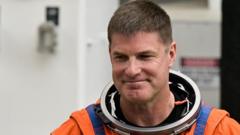
How a chance meeting shaped Canadian Jeremy Hansen's mission to the Moon
📖 Full Retelling
📚 Related People & Topics

NASA
American space and aeronautics agency
The National Aeronautics and Space Administration (NASA ) is an independent agency of the U.S. federal government responsible for the United States' civil space program and for research in aeronautics and space exploration. Headquartered in Washington, D.C., NASA operates ten field centers across th...
Canadian Astronaut Corps
Canadian Space Agency unit
The Canadian Astronaut Corps is a unit of the Canadian Space Agency (CSA) that selects, trains, and provides astronauts as crew members for U.S. and Russian space missions. As of 2025, the corps has four active members.

Jeremy Hansen
Canadian astronaut (born 1976)
Jeremy Roger Hansen (born January 27, 1976) is a Canadian astronaut, fighter pilot, physicist and aquanaut. He was selected to join the Canadian Space Agency in the 2009 CSA selection along with David Saint-Jacques. Prior to his selection as one of Canada's astronauts, Hansen was a Royal Canadian A...

Artemis program
NASA-led lunar exploration program
The Artemis program is a Moon exploration program led by the United States' National Aeronautics and Space Administration (NASA), formally established in 2017 through Space Policy Directive-1. The program intends to reestablish a human presence on the Moon for the first time since the Apollo 17 miss...
Entity Intersection Graph
Connections for NASA:
Mentioned Entities
Deep Analysis
Why It Matters
This news highlights the human element and serendipity behind space exploration, showing how personal connections can shape historic missions. It matters as it inspires public interest in Canada's role in the Artemis program and space science, potentially boosting STEM engagement. The story affects the Canadian space industry, international space partnerships, and the general public by making space exploration more relatable and accessible.
Context & Background
- Jeremy Hansen is a Canadian astronaut selected by the Canadian Space Agency (CSA) in 2009.
- He is part of NASA's Artemis II mission, scheduled to be the first crewed lunar flyby since Apollo 17 in 1972.
- Canada's involvement in Artemis is tied to its contribution of the Canadarm3 robotic system to the Lunar Gateway.
- Artemis II is planned for launch no earlier than September 2025, aiming to test systems for future lunar landings.
What Happens Next
Hansen and the Artemis II crew will continue training, with mission simulations and spacecraft testing leading up to the launch. Key milestones include finalizing the Orion spacecraft's readiness and conducting integrated mission rehearsals. Post-mission, data will inform Artemis III, which aims to land astronauts on the Moon, including the first woman and person of color.
Frequently Asked Questions
Jeremy Hansen is a mission specialist on Artemis II, responsible for operational tasks and representing Canada's contributions. He will help monitor spacecraft systems during the lunar flyby, contributing to mission success and international collaboration.
Canada gains access to lunar exploration opportunities, advances its space technology sector, and inspires STEM education. Participation secures a seat for a Canadian astronaut on future missions, enhancing the country's global standing in space exploration.
The article references a serendipitous encounter that influenced Hansen's path to becoming an astronaut, though details are unspecified. Such stories often involve mentors, colleagues, or events that sparked his interest or provided key opportunities in his career.
Artemis II is the first crewed mission to orbit the Moon since Apollo, testing new Orion spacecraft systems for deep space. It focuses on preparing for sustainable lunar exploration, unlike Apollo's short-term landings, and includes international crew members like Hansen.
Risks include technical failures during launch or flight, radiation exposure in deep space, and the challenges of re-entering Earth's atmosphere. Extensive testing and training aim to mitigate these, but space exploration inherently involves uncertainties.