
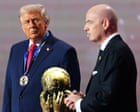
Infantino insists Trump has assured him Iran are ‘welcome’ to play at 2026 World Cup
#Infantino #Trump #Iran #2026 World Cup #FIFA #sports politics #World Cup hosting
📌 Key Takeaways
- FIFA President Gianni Infantino claims Donald Trump assured him Iran is welcome at the 2026 World Cup.
- The assurance addresses potential political tensions affecting Iran's participation.
- The 2026 World Cup is co-hosted by the U.S., Canada, and Mexico, with the U.S. as a key venue.
- Infantino's statement aims to reassure about inclusivity and political neutrality in sports.
📖 Full Retelling
🏷️ Themes
Sports Diplomacy, International Relations
📚 Related People & Topics

Iran
Country in West Asia
# Iran **Iran**, officially the **Islamic Republic of Iran** and historically known as **Persia**, is a sovereign country situated in West Asia. It is a major regional power, ranking as the 17th-largest country in the world by both land area and population. Combining a rich historical legacy with a...

FIFA
International governing body of association football
The Fédération Internationale de Football Association (FIFA; lit. 'International Association Football Federation' or 'International Federation of Association Football') is an international self-regulatory governing body of association football, beach football, and futsal. It was founded on 21 May 19...

Donald Trump
President of the United States (2017–2021; since 2025)
Donald John Trump (born June 14, 1946) is an American politician, media personality, and businessman who is the 47th president of the United States. A member of the Republican Party, he served as the 45th president from 2017 to 2021. Born into a wealthy New York City family, Trump graduated from the...
Entity Intersection Graph
Connections for Infantino:
View full profileMentioned Entities
Deep Analysis
Why It Matters
This news matters because it addresses geopolitical tensions affecting international sports, specifically whether Iran's national team will face travel restrictions to the United States for the 2026 World Cup. It affects Iranian athletes, global football governance, and diplomatic relations between the U.S. and Iran. The assurance from a former U.S. president could influence FIFA's planning and ease concerns about political interference in the tournament.
Context & Background
- The U.S. has maintained sanctions and travel restrictions on Iran for decades, with heightened tensions following the 2018 U.S. withdrawal from the Iran nuclear deal.
- Iran's national football team has previously faced logistical and political challenges in international competitions, including during the 2022 World Cup in Qatar.
- The 2026 World Cup will be co-hosted by the U.S., Canada, and Mexico, marking the first time the tournament will be held across three nations.
- FIFA President Gianni Infantino has frequently emphasized football's role in bridging political divides, advocating for inclusivity in global tournaments.
- Former U.S. President Donald Trump, who made the reported assurance, implemented strict travel bans during his administration, including restrictions affecting several Muslim-majority countries.
What Happens Next
FIFA will likely seek formal confirmation from current U.S. authorities regarding visa and entry protocols for Iranian players and officials. Diplomatic channels between the U.S. and Iran may be tested in the lead-up to the tournament, especially if geopolitical tensions escalate. The issue could resurface during the 2026 World Cup draw and preparatory events, with potential protests or boycotts from other nations depending on the outcome.
Frequently Asked Questions
Due to longstanding U.S. sanctions and travel restrictions on Iran, there were concerns that Iranian athletes might face visa denials or entry barriers. Political tensions between the two countries have historically complicated such exchanges.
As a former president and potential future candidate, Trump's statements may carry political weight but do not constitute official U.S. policy. Current administration decisions and State Department protocols will ultimately determine entry permissions.
FIFA has occasionally relocated matches or intervened diplomatically to ensure team participation, as seen with Crimea-related issues in European football. However, it generally avoids overt political stances, emphasizing neutrality.
If Iran receives clear access, it could set a precedent for teams from nations like Syria or Venezuela, which also face U.S. sanctions. Conversely, any barriers might lead to broader debates about politicization of sports.
While the U.S. generally ensures security for international events, political animosity could raise safety considerations. FIFA and host cities would need contingency plans to address potential protests or hostilities.