
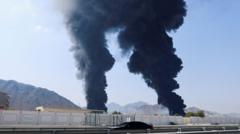
Iran hits key UAE oil port and Dubai airport
#Iran #UAE #oil port #Dubai airport #attack #Middle East #infrastructure
📌 Key Takeaways
- Iran launched attacks on a major UAE oil port and Dubai airport
- The strikes targeted critical infrastructure in the United Arab Emirates
- The incident escalates regional tensions in the Middle East
- The attacks could impact global oil supply and aviation operations
📖 Full Retelling
🏷️ Themes
Military Conflict, Regional Tensions
📚 Related People & Topics

United Arab Emirates
Country in West Asia
The United Arab Emirates (UAE), also known simply as the Emirates, is a country in West Asia, situated at the eastern end of the Arabian Peninsula. It is a federal semi-constitutional monarchy made up of seven emirates, with Abu Dhabi serving as its national capital. The UAE borders Oman to the east...

Iran
Country in West Asia
# Iran **Iran**, officially the **Islamic Republic of Iran** and historically known as **Persia**, is a sovereign country situated in West Asia. It is a major regional power, ranking as the 17th-largest country in the world by both land area and population. Combining a rich historical legacy with a...

Middle East
Transcontinental geopolitical region
The Middle East is a geopolitical region encompassing the Arabian Peninsula, Egypt, Iran, Iraq, the Levant, and Turkey. The term came into widespread usage by Western European nations in the early 20th century as a replacement of the term Near East (both were in contrast to the Far East). The term ...
Entity Intersection Graph
Connections for United Arab Emirates:
Mentioned Entities
Deep Analysis
Why It Matters
This attack directly threatens global energy security by targeting a major oil export hub that handles approximately 20% of the world's seaborne oil trade. It escalates regional tensions between Iran and Gulf Arab states, potentially drawing in international powers and disrupting critical shipping lanes. The targeting of Dubai International Airport, the world's busiest for international travel, creates widespread economic and travel disruptions affecting millions of passengers and global supply chains.
Context & Background
- The UAE and Iran have had strained relations for years over territorial disputes in the Gulf and differing regional alliances
- Fujairah port is crucial as it bypasses the Strait of Hormuz choke point where 30% of global oil shipments pass
- Tensions have escalated since the US withdrawal from the Iran nuclear deal in 2018 and subsequent sanctions
- Previous attacks on Gulf shipping and Saudi oil facilities in 2019 were attributed to Iran by Western powers
- The UAE has been normalizing relations with Israel through the Abraham Accords, angering Iran
What Happens Next
Immediate emergency UN Security Council meetings will likely be called within 24-48 hours. Oil prices are expected to spike 10-15% initially, with potential for further increases if retaliation occurs. The US Fifth Fleet based in Bahrain will probably increase patrols in the Strait of Hormuz. Regional airlines will reroute flights away from Dubai for at least 72 hours while damage assessments continue.
Frequently Asked Questions
Iran likely views this as retaliation against the UAE's alignment with US and Israeli interests in the region. The attack serves as a warning about Iran's capability to disrupt Gulf economies and demonstrates its reach beyond the Strait of Hormuz.
Prices will spike immediately due to supply concerns from Fujairah port disruptions. Long-term effects depend on damage severity and whether alternative shipping routes can compensate, potentially adding $15-25 per barrel if disruptions persist.
The US will probably deploy additional naval assets to the region and coordinate with Gulf allies on air defense. Diplomatic pressure through UN channels will intensify, with potential for new sanctions against Iranian entities.
All flights through Dubai International are suspended indefinitely for safety assessments. Travelers should expect cancellations and rerouting through alternative hubs like Doha or Abu Dhabi for the foreseeable future.
The risk of escalation is high given the strategic targets hit. However, both sides have historically avoided direct confrontation, suggesting proxy conflicts may intensify rather than full-scale war between nations.