
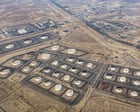
Iran war drives oil price above $100 a barrel for first time since 2022
#oil prices #Middle East conflict #Brent crude #energy markets #supply disruption #inflation #geopolitical risk
📌 Key Takeaways
- Oil prices exceeded $100 per barrel for first time since 2022
- Middle East conflict removing 20 million barrels daily from market
- Brent crude jumped 12.2% to $104.05 a barrel
- Asia Pacific markets led the price surge at week's start
📖 Full Retelling
🏷️ Themes
Energy Security, Geopolitical Conflict, Market Volatility
📚 Related People & Topics

Brent Crude
Classification of crude oil that serves as a major worldwide benchmark price
Brent Crude may refer to any or all of the components of the Brent Complex, a physically and financially traded oil market based around the North Sea of Northwest Europe; colloquially, Brent Crude usually refers to the price of the ICE (Intercontinental Exchange) Brent Crude Oil futures contract or ...

List of modern conflicts in the Middle East
List of Middle Eastern conflicts since 1914
This is a list of modern conflicts ensuing in the geographic and political region known as the Middle East. The "Middle East" is traditionally defined as the Fertile Crescent (Mesopotamia), Levant, and Egypt and neighboring areas of Arabia, Anatolia and Iran. It currently encompasses the area from E...
Entity Intersection Graph
Connections for Brent Crude:
Mentioned Entities
Deep Analysis
Why It Matters
The breach of $100 per barrel for oil is significant because it directly impacts global economic stability, consumer prices, and business operations worldwide. This price surge affects everything from transportation costs to manufacturing expenses, ultimately trickling down to consumers through higher prices for goods and services. Nations with high energy dependency, particularly developing economies, will face the most severe economic strain, while oil-importing countries may experience increased inflationary pressures and potentially slower economic growth.
Context & Background
- Oil prices last exceeded $100 per barrel in 2022 during the early stages of the Russia-Ukraine conflict
- The 2022 oil price surge was driven by supply concerns from the war in Ukraine and post-pandemic demand recovery
- Prior to 2022, oil prices had been relatively stable in the $60-80 range for several years
- The Middle East has historically been a flashpoint for oil supply disruptions, with previous conflicts in 1973, 1979, 1990, and 2001 causing significant price spikes
- The 1973 oil embargo quadrupled prices and triggered global economic recession
- The 2008 financial crisis saw oil prices peak at nearly $147 per barrel before crashing
- Post-2020 pandemic recovery saw prices gradually stabilize before recent Middle East tensions
What Happens Next
If the conflict in the Middle East continues to escalate, oil prices could potentially reach $110-120 per barrel in the coming weeks, depending on the extent of supply disruptions. Central banks in major economies may delay interest rate cuts or even consider rate hikes to combat inflationary pressures. Consumer nations, particularly those with high energy import dependency, may release strategic petroleum reserves to mitigate price impacts. The market will closely monitor diplomatic efforts to de-escalate tensions and any potential disruptions to major shipping routes like the Strait of Hormuz, through which approximately 20% of global oil supplies pass.
Frequently Asked Questions
$100 oil represents a significant increase from the $60-80 range seen in 2023 but is below the record high of nearly $147 per barrel reached in 2008. It's the first time prices have exceeded this threshold since 2022.
Oil-importing nations with high energy dependency, particularly India, Japan, China, and many European countries, will face the most severe economic impacts. Developing economies with limited fiscal buffers will be especially vulnerable.
Central banks may delay planned interest rate cuts or consider additional rate hikes to combat inflationary pressures. However, they must balance this against potential economic slowdown caused by higher energy costs.
Yes, the US has previously coordinated with other nations to release strategic petroleum reserves during price spikes. This could provide temporary relief but would not address the underlying supply concerns.
Higher oil prices typically lead to increased transportation costs, which translate to higher prices for goods and services. This could push inflation higher in many countries, potentially reversing recent progress in bringing inflation down to target levels.
The duration depends on the trajectory of the Middle East conflict. If tensions de-escalate quickly, prices could moderate within weeks. However, if the conflict persists or expands, elevated prices could continue for months.