
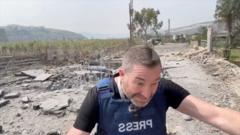
Israeli strike next to British journalist is not AI-generated
#Israeli strike #Steve Sweeney #RT journalist #Southern Lebanon #BBC verification #Iran war #Hezbollah #conflict journalism
📌 Key Takeaways
- British journalist Steve S narrowly survived Israeli strike in Lebanon
- Footage verified by BBC confirms authenticity, not AI-generated
- Strike occurred amid tensions with Hezbollah and Iran
- Journalists face significant dangers in conflict zones
📖 Full Retelling
🏷️ Themes
Middle East conflict, Journalism safety, Israel-Lebanon tensions
📚 Related People & Topics

Southern Lebanon
Geographic region of Lebanon
Southern Lebanon (Arabic: جنوب لبنان, romanized: Janūb Lubnān) is the area of Lebanon comprising the South Governorate and the Nabatiye Governorate. The two entities were divided from the same province in the early 1990s. The Rashaya and Western Beqaa districts, the southernmost districts of the Beq...
Entity Intersection Graph
No entity connections available yet for this article.
Mentioned Entities
Deep Analysis
Why It Matters
This incident highlights the extreme dangers journalists face while reporting from active conflict zones, particularly in the Middle East. The close call involving RT's Steve Sweeney underscores the real-time risks media personnel take to document events. The BBC's verification that the footage is authentic (not AI-generated) adds credibility to the reporting and comes at a time when media authenticity is increasingly scrutinized.
Context & Background
- Israel and Hezbollah have been in a state of conflict since Hezbollah's formation in the 1980s, with periodic escalations and ceasefires
- Southern Lebanon has been a frequent flashpoint in the Israel-Hezbollah conflict, with both sides engaging in cross-border attacks
- Journalists have frequently been caught in the crossfire in Middle East conflicts, with many being injured or killed while reporting
- RT (Russia Today) is a Russian state-funded international broadcaster that often reports from conflict zones with a particular perspective
- The BBC has a long-standing reputation for fact-checking and verifying content, especially in conflict situations
- There has been growing global concern about AI-generated content being used to spread misinformation and manipulate public perception
What Happens Next
The incident may lead to increased calls for protection of journalists in conflict zones and could potentially be used by various parties to highlight different aspects of the Israel-Hezbollah conflict. RT may continue to report on the dangers faced by journalists in the region, while the BBC's verification process may be referenced in future discussions about media authenticity. There may also be investigations into whether the strike was intentional or accidental, potentially affecting the already fragile security situation in southern Lebanon.
Frequently Asked Questions
Steve Sweeney is the Lebanon bureau chief for RT, a Russian state-funded international broadcaster. He was broadcasting live from southern Lebanon when the missile strike occurred near his position.
In an era of increasing AI-generated content, verification helps establish the authenticity of events and prevents misinformation. This confirmation by the BBC adds significant credibility to the reported incident.
Israel and Hezbollah have been in a state of conflict since Hezbollah's formation in the 1980s. They have fought multiple wars and engage in regular hostilities, particularly along the Israel-Lebanon border.
Journalists in conflict zones frequently face dangers, with many being injured or killed while reporting on conflicts worldwide. Organizations like Reporters Without Borders regularly document these incidents and advocate for journalist protection.
RT is a Russian state-funded international broadcaster that provides news and programming from a Russian perspective. It often focuses on international conflicts and geopolitical issues, sometimes challenging mainstream Western narratives.