
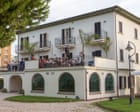
Italian council buys Mussolini’s villa to keep it away from ‘fascist nostalgics’
📖 Full Retelling
📚 Related People & Topics

Italy
Country in Southern and Western Europe
Italy, officially the Italian Republic, is a country in Southern and Western Europe. It consists of a peninsula that extends into the Mediterranean Sea, with the Alps on its northern land border, as well as nearly 800 islands, notably Sicily and Sardinia. Italy shares land borders with France to the...

Benito Mussolini
Dictator of Italy from 1922 to 1943
Benito Amilcare Andrea Mussolini (29 July 1883 – 28 April 1945) was an Italian politician and journalist who led Italy as Il Duce from 1922 until his overthrow in 1943. He founded the fascist movement in 1919 with the creation of the Fasci Italiani di Combattimento, which became the National Fascist...
Entity Intersection Graph
Connections for Italy:
Mentioned Entities
Deep Analysis
Why It Matters
This news matters because it involves a significant historical property linked to Benito Mussolini, Italy's fascist dictator from 1922 to 1943, and reflects ongoing efforts to prevent its use by far-right groups. It affects Italian society by addressing the legacy of fascism, potentially influencing public memory and political symbolism. The purchase by a local council underscores governmental responsibility in managing controversial heritage, impacting cultural policy and anti-extremism measures.
Context & Background
- Benito Mussolini ruled Italy as a fascist dictator from 1922 until his overthrow in 1943, aligning with Nazi Germany during World War II.
- Mussolini's regime promoted authoritarianism, nationalism, and suppression of opposition, leaving a complex legacy that Italy continues to grapple with post-war.
- The villa in question, likely one of Mussolini's residences, has historical significance and has been a site of interest for far-right groups seeking to glorify fascist ideology.
- Italy has laws against the apology of fascism, and public efforts to distance from fascist symbols have increased in recent decades amid rising far-right movements in Europe.
What Happens Next
The local council will likely develop plans for the villa's future use, possibly converting it into a museum, educational center, or public space to promote historical awareness and counter fascist narratives. There may be public debates or legal processes regarding its management, with potential announcements in the coming months. Monitoring for reactions from far-right groups and further governmental actions to secure similar sites could follow.
Frequently Asked Questions
The council purchased the villa to prevent it from being acquired by 'fascist nostalgics' or far-right groups who might use it to glorify Mussolini's regime, aiming to control its historical narrative and promote anti-fascist values.
The villa served as a residence for Benito Mussolini during his fascist rule, symbolizing his power and the authoritarian era in Italy, making it a potent site for memory and political symbolism related to World War II and fascism.
It reflects ongoing efforts in Italy to address fascist legacies amid rising far-right movements, with the council taking proactive steps to prevent the misuse of historical sites and uphold democratic principles against extremism.
The villa could be repurposed for educational or public use, such as a museum or community center, to foster historical reflection and discourage fascist nostalgia, with details to be determined by the council's plans.