
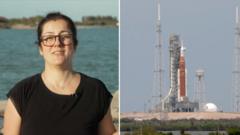
'It's phenomenal!': Excitement in Florida ahead of Artemis launch
📖 Full Retelling
📚 Related People & Topics

NASA
American space and aeronautics agency
The National Aeronautics and Space Administration (NASA ) is an independent agency of the U.S. federal government responsible for the United States' civil space program and for research in aeronautics and space exploration. Headquartered in Washington, D.C., NASA operates ten field centers across th...

Artemis
Goddess of the hunt and the wild in ancient Greek religion and mythology
In ancient Greek religion and mythology, Artemis (; Ancient Greek: Ἄρτεμις) is the goddess of hunting, the wilderness, wild animals, transitions, nature, vegetation, childbirth, care of children, and chastity. In later times, she was identified with Selene, the personification of the Moon. She was o...

Kennedy Space Center
U.S. space launch site in Florida
The John F. Kennedy Space Center (KSC, originally known as the NASA Launch Operations Center), located on Merritt Island, Florida, is one of the ten field centers of NASA. Since 1968, KSC has been NASA's primary launch center of American spaceflight, research, and technology. Launch operations for t...

Florida
U.S. state
Florida ( FLORR-ih-də; Spanish: [floˈɾiða] ) is a state in the Southeastern and South Atlantic regions of the United States. It borders the Gulf of Mexico to the west, Alabama to the northwest, Georgia to the north, the Atlantic Ocean to the east, the Straits of Florida to the south, and The Bahama...
Entity Intersection Graph
Connections for NASA:
Mentioned Entities
Deep Analysis
Why It Matters
The Artemis launch represents humanity's return to lunar exploration after 50 years, marking a crucial step toward establishing a sustainable presence on the Moon and eventually reaching Mars. This mission directly impacts NASA's international partners, commercial space companies, and scientific communities worldwide who are invested in space exploration. For Florida's Space Coast, the launch brings significant economic benefits through tourism and aerospace employment, while inspiring a new generation of scientists and engineers. The success of Artemis I will validate new technologies and systems essential for future crewed missions, making it a pivotal moment for 21st-century space exploration.
Context & Background
- The Artemis program is NASA's initiative to return humans to the Moon, named after Apollo's twin sister in Greek mythology
- The last human Moon landing was Apollo 17 in 1972, making this the first lunar-focused human spaceflight program in five decades
- Artemis I is an uncrewed test flight using NASA's new Space Launch System (SLS) rocket and Orion spacecraft, which have been in development for over a decade
- The program aims to land the first woman and first person of color on the Moon, representing a more diverse era of space exploration
- International partnerships include the European Space Agency (providing Orion's service module), Canada (contributing robotic arm technology), and other nations through the Artemis Accords
What Happens Next
Following the successful launch, Artemis I will embark on a 25.5-day mission traveling 1.3 million miles, including a distant retrograde orbit around the Moon before returning to Earth. If this uncrewed test succeeds, Artemis II will launch in 2024-2025 with astronauts for a lunar flyby mission. Artemis III is scheduled for 2025-2026 to land astronauts near the lunar south pole, where water ice deposits could support future lunar bases. Subsequent missions will establish the Lunar Gateway space station and surface habitats for extended human presence.
Frequently Asked Questions
NASA's Kennedy Space Center in Florida has been America's primary launch site since 1962, offering geographic advantages including proximity to the equator for Earth's rotational boost and ocean access for safe rocket stage disposal. The existing infrastructure from the Space Shuttle and Apollo programs has been upgraded to support Artemis launches.
Artemis utilizes modern technology including more powerful rockets, advanced computers, and international collaboration. While Apollo was a Cold War-era sprint to the Moon, Artemis aims for sustainable exploration with plans for lunar bases, resource utilization, and preparation for Mars missions.
NASA will provide live coverage on NASA Television, the agency's website, and social media platforms. Spectators can view from designated areas around Kennedy Space Center and along Florida's Space Coast, with optimal viewing locations including Titusville, Cocoa Beach, and Playalinda Beach.
Artemis I will test the SLS rocket's performance, Orion spacecraft's systems in deep space, and the heat shield during high-speed reentry. The mission will also deploy small satellites called CubeSats for lunar science and demonstrate operations for future crewed missions.
NASA has backup launch dates typically within days of the initial attempt, depending on orbital mechanics and technical readiness. The agency maintains flexibility to address weather concerns or technical issues while preserving the mission's trajectory requirements for reaching the Moon.