
Killer 'should have been arrested before attacks'
#Nottingham attacks #Valdo Calocane #Police warrant #Kate Meynell #Nottinghamshire Police #Nottingham Inquiry #Arrest failure #Bereaved families
📌 Key Takeaways
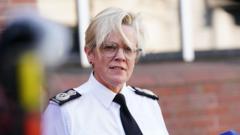
- Former Nottinghamshire Police Chief Constable Kate Meynell admitted Valdo Calocane should have been arrested before the attacks
- An outstanding arrest warrant issued in September 2022 was never executed despite multiple opportunities
- The inquiry revealed significant failures in communication with both bereaved families and survivors
- Nottinghamshire Police has completely changed the way warrants are managed since the killings
📖 Full Retelling
🏷️ Themes
Police Failure, Justice System, Accountability
📚 Related People & Topics

Nottinghamshire Police
English territorial police force
# Nottinghamshire Police **Nottinghamshire Police** is the territorial police force responsible for policing the geographic county of Nottinghamshire, including the city and unitary authority of Nottingham, situated in the East Midlands region of England. ### Jurisdiction and Demographics The forc...
Warrant (law)
Order that serves as a specific type of authorization
A warrant is generally an order that serves as a specific type of authorization, that is, a writ issued by a competent officer, usually a judge or magistrate, that permits an otherwise illegal act that would violate individual rights in order to enforce the law and aid in investigations; affording t...

2023 Nottingham attacks
Vehicle-ramming and stabbing attacks in England
In the early morning of 13 June 2023, three people were fatally stabbed and three others were injured when a van was driven into them in three connected attacks in Nottingham in the East Midlands of the United Kingdom. At around 04:00 BST, Valdo Calocane fatally stabbed two university students in th...
Entity Intersection Graph
No entity connections available yet for this article.
Mentioned Entities
Deep Analysis
Why It Matters
This admission highlights critical police failures that potentially allowed a triple killer to remain free, raising serious questions about police accountability and warrant tracking systems. The families of victims deserve answers and assurance that such systemic failures won't happen again, affecting public trust in law enforcement and the justice system. This case underscores how administrative errors can have devastating consequences for public safety.
Context & Background
- Valdo Calocane carried out deadly attacks in Nottingham on June 13, 2023, killing Barnaby Webber, Grace O'Malley-Kumar and Ian Coates, and attempting to kill three others
- A warrant was issued in September 2022 after Calocane failed to appear in court for assaulting a police officer in 2021
- Calocane assaulted two warehouse workers in Kegworth, Leicestershire on May 5, 2023, weeks before the killings, with officers seeing the outstanding warrant but not pursuing it
- Kate Meynell retired as Chief Constable three days before making this admission at the Nottingham Inquiry
- The inquiry is being overseen by retired senior judge Deborah Taylor KC
What Happens Next
The Nottingham Inquiry in London will continue to investigate police failures and call further testimony from other officials involved in the case. The investigation into officers' misconduct, including offensive WhatsApp messages about the attacks, will proceed separately. Families may pursue legal action against the police force, and Nottinghamshire Police will likely implement reforms regarding warrant tracking and communication protocols to prevent similar failures.
Frequently Asked Questions
On June 13, 2023, Valdo Calocane stabbed to death Barnaby Webber, Grace O'Malley-Kumar and Ian Coates, and attempted to kill three others in Nottingham, with police later admitting he should have been arrested earlier due to an outstanding warrant.
The warrant was issued on a police computer system but went to an inbox that wasn't being monitored regularly, and despite officers seeing the warrant when Calocane assaulted warehouse workers in May 2023, it wasn't pursued.
There were 'fundamental failures of communication' with both bereaved families and surviving victims, who felt 'forgotten' by police, and families only learned about misconduct investigations through media reports rather than being informed directly.
The police force may face institutional criticism, potential legal action from families, and will likely need to implement reforms to warrant tracking and communication protocols to restore public confidence.
Kate Meynell was the Chief Constable of Nottinghamshire Police who retired three days before making this admission at the Nottingham Inquiry, where she acknowledged police failures in the Calocane case.