| United Kingdom
| politics
| ✓ Verified - theguardian.com
Nasa may roll back Artemis II rocket launch after helium flow discovery
#Artemis II#NASA#Rocket Launch#Helium Flow#Kennedy Space Center#Moon Mission#Astronauts
📌 Key Takeaways
NASA discovered interrupted helium flow in Artemis II rocket
Rocket may be rolled back to vehicle assembly building
March launch window now in jeopardy
Four astronauts preparing for 10-day lunar orbit mission
Mission prepares way for 2028 Artemis III lunar landing
📖 Full Retelling
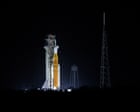
NASA announced on Saturday it is considering rolling back the Artemis II rocket launch from the Kennedy Space Center in Florida after discovering an interrupted flow of helium in the rocket's interim cryogenic propulsion stage, just one day after setting a March 6 target for the astronauts' moon mission. The agency stated in a blog post that it is taking steps to potentially move the Artemis II rocket and Orion spacecraft back to the vehicle assembly building, noting that this development will almost certainly impact the March launch window. The helium flow interruption was observed overnight and represents a critical issue since proper helium flow is required for launch operations. This setback comes after NASA had successfully completed a fueling test earlier in the month that had previously caused delays. The Artemis II mission, designed to send four astronauts on a 10-day trip around the moon without landing, represents a significant milestone in space exploration. The crew consists of three Americans—Reid Wiseman, Victor Glover, and Christina Koch—and one Canadian, Jeremy Hansen, who were preparing for their second quarantine period in anticipation of the launch. The mission will test critical systems for future deep-space exploration and will fly approximately 4,700 miles beyond the far side of the moon, surpassing the distance record set by Apollo 13 in 1970. This mission serves as preparation for Artemis III, scheduled for 2028, which aims to achieve the first human lunar landing since the final Apollo mission in 1972.
🏷️ Themes
Space Exploration, NASA Operations, Lunar Missions
The National Aeronautics and Space Administration (NASA ) is an independent agency of the U.S. federal government responsible for the United States' civil space program and for research in aeronautics and space exploration. Headquartered in Washington, D.C., NASA operates ten field centers across th...
Artemis II is a planned lunar spaceflight mission under the Artemis program, led by NASA. It is intended to be the second flight of the Space Launch System (SLS), and the first crewed mission of the Orion spacecraft. It is the first crewed mission around the Moon, and beyond low Earth orbit, since A...
The John F. Kennedy Space Center (KSC, originally known as the NASA Launch Operations Center), located on Merritt Island, Florida, is one of the ten field centers of NASA. Since 1968, KSC has been NASA's primary launch center of American spaceflight, research, and technology. Launch operations for t...
NASA's Artemis II launch delay highlights the critical role of helium in rocket propulsion and underscores the challenges of meeting tight launch schedules. The postponement could affect the broader Artemis program timeline and the planned return of humans to lunar orbit.
Context & Background
Artemis II aims to send four astronauts around the moon in early March
Helium flow interruption discovered in the rocket's cryogenic propulsion stage
NASA has moved the vehicle back to the assembly building to investigate
What Happens Next
NASA will conduct a thorough review of the helium system and may reschedule the launch to a later date in March. The crew will remain in quarantine while the agency addresses the issue, and the Artemis II timeline will be updated once the investigation is complete.
Frequently Asked Questions
Why was the Artemis II launch postponed?
Because an interrupted helium flow was detected, which is essential for rocket propulsion.
When might the launch be rescheduled?
NASA has not set a new date yet, but it could be later in March after the investigation.
Will the crew still be on the Artemis II mission?
Yes, the astronauts remain on the mission and will wait for the new launch window.
}
Original Source
Nasa may roll back Artemis II rocket launch after helium flow discovery Agency statement comes one day after announcement of 6 March target for astronauts’ mission to circle the moon Nasa said in a blog post on Saturday it is taking steps to potentially roll back the Artemis II rocket launch after discovering an interrupted flow of helium. The agency said it is taking steps to roll the Artemis II rocket and Orion spacecraft back to the vehicle assembly building at the Kennedy Space Center in Florida. “This will almost assuredly impact the March launch window,” Nasa said. The agency observed overnight an interrupted flow of helium in the space launch system rocket’s interim cryogenic propulsion stage. Helium flow is required for launch. Nasa had said on Friday it was targeting 6 March for the launch of four astronauts around the moon and back as part of its Artemis II mission after successfully completing a fueling test that had caused it to stand down earlier this month. The Artemis II mission’s four astronauts, three Americans – Reid Wiseman, Victor Glover and Christina Koch – and one Canadian, Jeremy Hansen, were entering a second period of quarantine on Friday in anticipation of the new target launch date, which Nasa announced “with caveats” because it said there was still much preparatory work to do after Thursday’s fueling test. Nasa has several dates available in early March to launch Artemis, which will conduct a 10-day trip around the moon, but not land. The flight will take humans further into space then ever before and, according to Nasa, the mission will fly about 4,700 miles (7,600km) beyond the far side of the moon, surpassing the distance record set by Apollo 13 in 1970. The mission will test systems for future deep-space exploration. The mission is in preparation for Artemis III, scheduled for 2028, which will be the first human landing on the moon since the final Apollo program flight in December 1972. Richard Luscombe contributed reporting Explore m...