
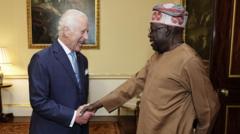
Nigeria president begins first UK state visit in 37 years
#Nigeria #UK #state visit #Bola Tinubu #diplomacy #economic cooperation #bilateral ties
📌 Key Takeaways
- President Bola Tinubu of Nigeria is undertaking the first UK state visit by a Nigerian leader in 37 years.
- The visit aims to strengthen bilateral ties and discuss economic cooperation between Nigeria and the United Kingdom.
- Key agenda items include security collaboration, trade, and investment opportunities in sectors like energy and infrastructure.
- The visit is seen as a significant diplomatic effort to enhance Nigeria's global partnerships and address mutual challenges.
📖 Full Retelling
🏷️ Themes
Diplomacy, Bilateral Relations
📚 Related People & Topics

Bola Tinubu
President of Nigeria since 2023
Asiwaju Bola Ahmed Adekunle Tinubu (born 29 March 1952) is a Nigerian politician serving as the 16th and current president of Nigeria since 2023. He previously served as the governor of Lagos State from 1999 to 2007 and senator for Lagos West in the Third Republic. Tinubu spent his early life in so...

Nigeria
Country in West Africa
Nigeria, officially the Federal Republic of Nigeria, is a country in West Africa between the Sahel to the north and the Gulf of Guinea in the Atlantic Ocean to the south. It covers an area of 923,769 square kilometres (356,669 mi2). With a population of more than 236 million, it is the most populous...

United Kingdom
Country in northwestern Europe
The United Kingdom of Great Britain and Northern Ireland, commonly known as the United Kingdom (UK) or Britain, is a country in northwestern Europe, off the coast of the continental mainland. It comprises England, Scotland, Wales and Northern Ireland, with a population of over 69 million in 2024. Th...
Entity Intersection Graph
Connections for Bola Tinubu:
View full profileMentioned Entities
Deep Analysis
Why It Matters
This state visit marks a significant diplomatic milestone as it's the first official UK state visit by a Nigerian president in nearly four decades, signaling a potential reset in bilateral relations between two major Commonwealth nations. The visit matters because Nigeria is Africa's largest economy and most populous country, making it a crucial partner for the UK in trade, security cooperation, and regional influence. It affects Nigerian and British businesses seeking investment opportunities, security agencies combating regional terrorism, and diaspora communities in both countries. The timing is particularly important as both nations navigate post-Brexit trade relationships and Nigeria faces critical elections next year.
Context & Background
- The last Nigerian president to make a UK state visit was Shehu Shagari in 1985, before he was overthrown in a military coup later that year
- UK-Nigeria relations have been historically complex, shaped by colonial history, Nigeria's independence in 1960, and periods of military rule
- Nigeria is the UK's second-largest trading partner in Africa, with bilateral trade worth approximately £6.2 billion in 2021
- The UK hosts one of the largest Nigerian diaspora communities globally, estimated at over 200,000 people
- Recent years have seen tensions over issues including visa restrictions, return of stolen artifacts, and security cooperation in combating Boko Haram
What Happens Next
Expect announcements of new trade agreements and investment deals during the visit, particularly in energy and infrastructure sectors. Security cooperation agreements addressing terrorism in West Africa will likely be strengthened. The visit will set the stage for Nigeria's February 2023 presidential elections, where UK-Nigeria relations could influence international observer missions and post-election dynamics. Follow-up ministerial meetings are anticipated within 6-12 months to implement agreements reached during this state visit.
Frequently Asked Questions
Political instability including military coups, periods of diplomatic tension, and changing geopolitical priorities contributed to the long gap. Nigeria experienced multiple military regimes between 1985-1999, and more recently both countries have focused on relationships with other global powers.
Key agenda items include strengthening economic ties through trade agreements, enhancing security cooperation against regional terrorist groups, discussing climate change initiatives, and addressing diaspora concerns. The visit also serves symbolic diplomatic purposes to reaffirm the UK-Nigeria partnership.
Potential benefits could include increased UK investment creating jobs, improved security cooperation against extremist groups, and possibly streamlined visa processes for students and professionals. However, outcomes will depend on implementation of agreements reached during the visit.
Nigeria represents a crucial emerging market for UK trade as Britain seeks new global partnerships after leaving the EU. As Africa's largest economy, Nigeria offers significant opportunities in sectors like renewable energy, technology, and financial services that align with UK economic interests.
Yes, discussions will likely address the return of Benin Bronzes and other cultural artifacts, UK visa restrictions affecting Nigerian citizens, and differing approaches to climate change given Nigeria's oil industry. Human rights concerns and election integrity may also surface in private discussions.