
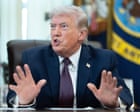
Oil price falls and markets rally after Trump says Iran war over in ‘two to three weeks’
📖 Full Retelling
📚 Related People & Topics

Middle East
Transcontinental geopolitical region
The Middle East is a geopolitical region encompassing the Arabian Peninsula, Egypt, Iran, Iraq, the Levant, and Turkey. The term came into widespread usage by Western European nations in the early 20th century as a replacement of the term Near East (both were in contrast to the Far East). The term ...
List of wars involving Iran
This is a list of wars involving the Islamic Republic of Iran and its predecessor states. It is an unfinished historical overview.

Donald Trump
President of the United States (2017–2021; since 2025)
Donald John Trump (born June 14, 1946) is an American politician, media personality, and businessman who is the 47th president of the United States. A member of the Republican Party, he served as the 45th president from 2017 to 2021. Born into a wealthy New York City family, Trump graduated from the...
Entity Intersection Graph
Connections for Middle East:
Mentioned Entities
Deep Analysis
Why It Matters
This news matters because it directly impacts global energy markets, geopolitical stability in the Middle East, and investor confidence worldwide. The statement from a major world leader about conflict resolution affects oil prices, which influence everything from transportation costs to inflation rates. It reassures markets that potential supply disruptions from a major oil-producing region might be avoided, benefiting consumers and businesses globally while reducing geopolitical risk premiums.
Context & Background
- Iran is OPEC's third-largest oil producer with approximately 3.8 million barrels per day output capacity
- The Strait of Hormuz, which Iran borders, handles about 20% of global oil trade and 30% of seaborne oil shipments
- Previous tensions between the U.S. and Iran have caused oil price spikes exceeding 10% in single trading sessions
- The U.S. reinstated sanctions on Iranian oil exports in 2018 after withdrawing from the nuclear deal
- Middle East conflicts historically create volatility in energy markets due to supply disruption fears
What Happens Next
Markets will closely monitor actual de-escalation measures between the U.S. and Iran over the next 2-3 weeks. Oil traders will watch for changes in Iranian export patterns and military posturing in the Persian Gulf. If tensions genuinely ease, OPEC+ may reconsider production cuts scheduled for their March meeting. Diplomatic channels may reopen for potential negotiations on Iran's nuclear program and regional activities.
Frequently Asked Questions
Oil prices incorporate a 'risk premium' during conflicts that accounts for potential supply disruptions. When tensions decrease, this premium evaporates as the likelihood of supply interruptions diminishes. Lower prices reflect restored confidence in stable oil flows from conflict-prone regions.
Lower oil prices typically translate to cheaper gasoline and heating costs within weeks. Reduced energy expenses leave consumers with more disposable income for other purchases. Businesses also benefit from lower transportation and production costs, potentially leading to broader economic stimulation.
If military incidents continue despite diplomatic statements, markets could reverse their optimism quickly. Internal political pressures in either country could prevent actual de-escalation. Other Middle Eastern actors or proxy groups might continue hostilities independently of government positions.
Geopolitical forecasts are notoriously uncertain, especially regarding conflict timelines. Previous Middle East conflicts have often defied early resolution predictions. Markets typically react to statements but remain sensitive to actual on-ground developments and intelligence reports.
Transportation sectors (airlines, shipping, trucking) benefit immediately from lower fuel costs. Manufacturing and consumer goods companies gain from reduced energy expenses. Financial markets generally rally as uncertainty decreases and economic growth prospects improve.