
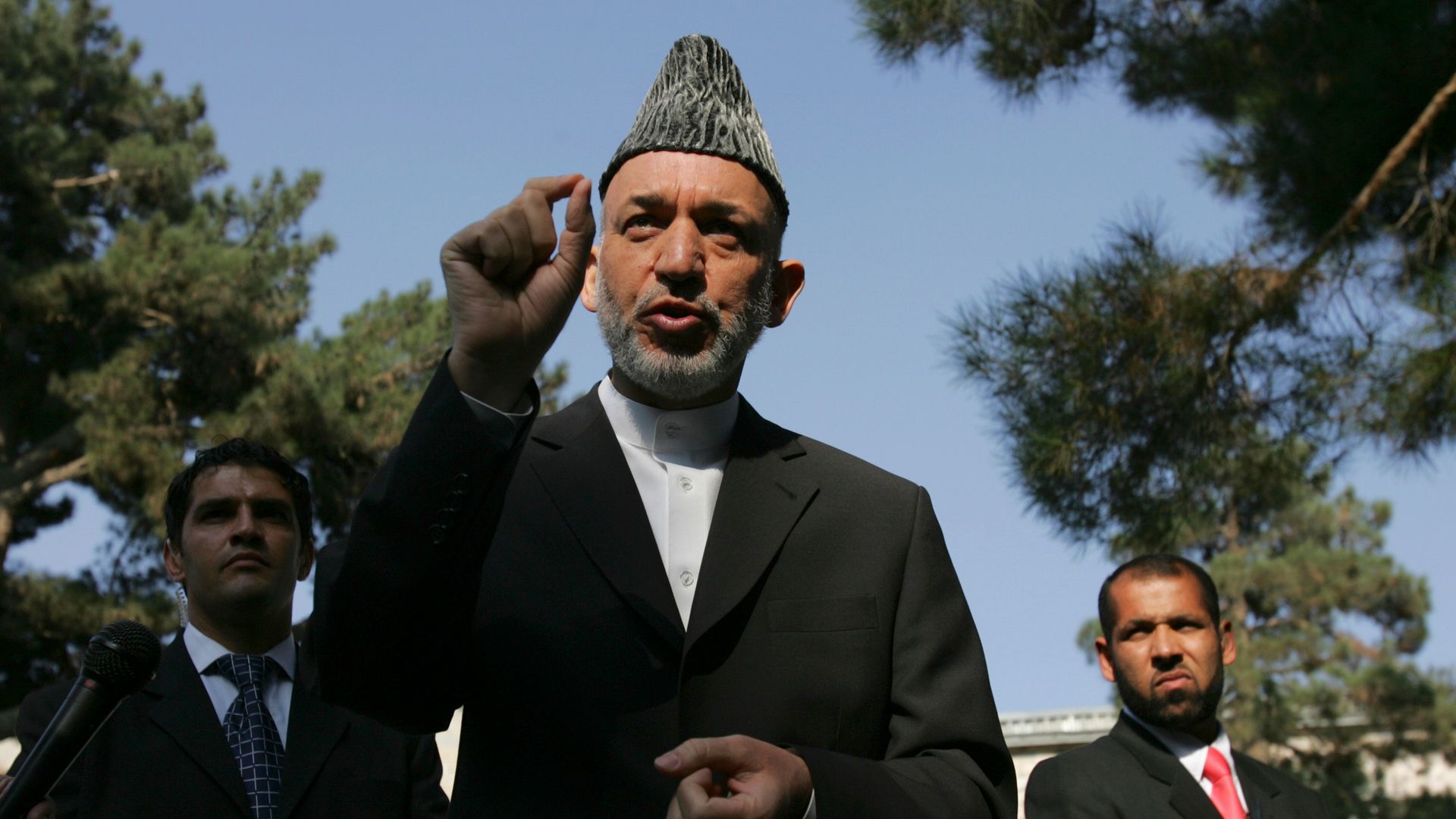
Pakistani government wants to 'create anarchy' in Afghanistan, claims Hamid Karzai
#Hamid Karzai #Pakistan #Afghanistan #Anarchy #Geopolitical tensions #Regional stability #Taliban #Diplomatic relations
📌 Key Takeaways
- Former Afghan president Hamid Karzai accuses Pakistan of promoting anarchy in Afghanistan
- Karzai claims Pakistan's goal is to keep Afghanistan perpetually downtrodden
- The allegations reflect decades of strained relations between the two neighboring countries
- The accusations come amid heightened regional security concerns following the Taliban's return to power
📖 Full Retelling
🏷️ Themes
Geopolitical tensions, Regional stability
📚 Related People & Topics
Anarchy
Society without rulers
Anarchy is a form of society without rulers. As a type of stateless society, it is commonly contrasted with states, which are polities that claim a monopoly on violence over a permanent territory. Beyond a lack of government, it can more precisely refer to societies that lack any form of authority ...

Pakistan
Country in South Asia
Pakistan, officially the Islamic Republic of Pakistan, is a country in South Asia. It is the fifth-most populous country, with a population of over 241.5 million, having the second-largest Muslim population as of 2023. Islamabad is the nation's capital, while Karachi is its largest city and financia...

Afghanistan
Country in Central and South Asia
Afghanistan, officially the Islamic Emirate of Afghanistan, is a landlocked country located at the crossroads of Central and South Asia. It is bordered by Pakistan to the east and south, Iran to the west, Turkmenistan to the northwest, Uzbekistan to the north, Tajikistan to the northeast, and China ...

Hamid Karzai
President of Afghanistan from 2002 to 2014
Hamid Karzai (born 24 December 1957) is an Afghan politician who served as the seventh president of Afghanistan from 2002 to 2014, including as the first president of the Islamic Republic of Afghanistan from 2004 to 2014. He also served as chairman of the Afghan Interim Administration from 2001 to 2...
Entity Intersection Graph
No entity connections available yet for this article.
Mentioned Entities
Deep Analysis
Why It Matters
The accusations by former Afghan president Hamid Karzai against Pakistan represent a significant escalation in diplomatic tensions between two neighboring countries with a long history of mistrust. This development could further complicate efforts to establish stable diplomatic relations and regional cooperation, particularly as Afghanistan navigates its post-intervention era under Taliban rule. The allegations also highlight ongoing geopolitical competition in South Asia, which could potentially lead to increased proxy conflicts and instability in a region already facing numerous security challenges.
Context & Background
- Pakistan and Afghanistan share a porous border and have had complex relations since Afghanistan's creation in the 18th century
- During the Soviet-Afghan War (1979-1989), Pakistan's ISI intelligence agency supported Afghan mujahideen fighters, including future Taliban leaders
- After the Taliban's rise to power in 1996, Pakistan was one of only three countries to recognize the regime
- Following the 2001 US-led invasion of Afghanistan, Pakistan officially supported the US effort but was accused of maintaining ties with the Taliban
- Throughout the 2000s and 2010s, multiple Afghan governments accused Pakistan of supporting the Taliban and other militant groups
- Relations deteriorated significantly after the 2021 Taliban takeover of Afghanistan, with both countries expelling diplomats
- The region has become a focal point for geopolitical competition between Pakistan, India, China, and other regional powers
What Happens Next
Karzai's accusations are likely to further strain already tense diplomatic relations between Pakistan and Afghanistan. The Taliban government in Afghanistan may either distance itself from or endorse these views, depending on their current diplomatic strategy with Pakistan. Regional powers including China, Russia, and the United States may attempt to mediate tensions, though their effectiveness will be limited by competing interests. Additionally, militant activity along the Pakistan-Afghanistan border could potentially increase as a result of heightened tensions, further destabilizing the region.
Frequently Asked Questions
Pakistan has historically sought strategic depth in Afghanistan to counter Indian influence and prevent hostile governments from forming on its western border. A weaker, divided Afghanistan has been seen by some in Pakistan as preferable to a strong, unified state aligned with India.
While Karzai didn't provide specific evidence in his statement, numerous reports over the years have documented Pakistan's alleged support for the Taliban and other militant groups. However, Pakistan has consistently denied these accusations, calling them baseless propaganda.
The Taliban government has maintained complex relations with Pakistan, seeking support while attempting to project independence. Karzai's accusations could create internal divisions within the Taliban leadership regarding how to manage their relationship with Pakistan.
Regional powers like India, China, Iran, and Russia all have interests in Afghanistan-Pakistan relations. The United States maintains influence despite its withdrawal, and Pakistan's relationship with China adds another layer of complexity to the regional dynamics.
While direct military conflict remains unlikely, both countries have engaged in cross-border military operations in the past. Heightened tensions could increase the risk of border incidents, though both sides typically prefer to avoid direct confrontation.