
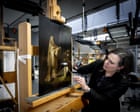
Rijksmuseum reveals painting to be early work by Rembrandt
📖 Full Retelling
<p>17th-century Dutch master’s Vision of Zacharias in the Temple to go on display this week</p><p>It hung unrecognised on the wall of a private home for decades but now a 17th-century painting has been revealed as a Rembrandt, taking its potential value from thousands to millions of pounds.</p><p>The Rijksmuseum announced on Monday that it had rediscovered an early biblical scene by the Dutch master that was once thought lost, thanks to hi-tech scanning and two year
Entity Intersection Graph
No entity connections available yet for this article.
Original Source
Rijksmuseum reveals painting to be early work by Rembrandt 17th-century Dutch master’s Vision of Zacharias in the Temple to go on display this week It hung unrecognised on the wall of a private home for decades but now a 17th-century painting has been revealed as a Rembrandt , taking its potential value from thousands to millions of pounds. The Rijksmuseum announced on Monday that it had rediscovered an early biblical scene by the Dutch master that was once thought lost, thanks to hi-tech scanning and two years of expert analysis. Since the 1960s, Vision of Zacharias in the Temple, dated 1633, had been attributed to Rembrandt’s “workshop”, meaning it was believed to have been created by a lesser-known artist such as Jan Lievens or Salomon Koninck. But in fact it was a work of the old master, the Dutch museum announced, as it prepared to exhibit the painting this week. Taco Dibbits, the general director of the Rijksmuseum, said they were approached several years ago by a couple who had inherited a modest-looking painting from their father. “It was really very dark,” Dibbits said. “But when it had been restored, I came in to see it and it really looked like the gold was bursting off it – which, of course, is remarkable because he painted with yellow and not with gold. This is what makes the artist a true artist … It is classic Rembrandt.” The painting depicts the biblical story of the high priest Zechariah, who is visited by the archangel Gabriel and told that he and his wife – despite their advanced age – will have a son, John, later John the Baptist. It does not show an angel, only a bright light in one corner and the priest’s face in disbelief. Jonathan Bikker, a curator of 17th-century Dutch painting at the Rijksmuseum and the author of an academic article in the Burlington Magazine about the attribution, said the find was extraordinary. He and the article’s co-author, Petria Noble, argue that the painting was discredited in 1969 by the scholar Horst Gerson and la...
Read full article at source