
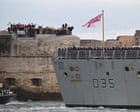
Royal Navy’s HMS Dragon sails for eastern Mediterranean
#Royal Navy #HMS Dragon #eastern Mediterranean #deployment #maritime patrol #defense #UK military
📌 Key Takeaways
- HMS Dragon, a Royal Navy destroyer, has been deployed to the eastern Mediterranean.
- The deployment is part of ongoing regional security operations.
- The ship's mission includes maritime patrol and defense duties.
- This move underscores the UK's military presence in a strategically important area.
📖 Full Retelling
🏷️ Themes
Military Deployment, Maritime Security
📚 Related People & Topics
HMS Dragon
List of ships with the same or similar names
Several ships of the Royal Navy have been named HMS Dragon. English ship Dragon (1512), a ship of 100 tons built in 1512 under Sir William Sidney in the war with France. Last mentioned 1514.

Royal Navy
Naval warfare force of the United Kingdom
The Royal Navy (RN) is the naval warfare force of the United Kingdom, responsible for defending the UK, the Crown Dependencies, and the Overseas Territories from naval attack or invasion. It is a component of His Majesty's Naval Service, and its officers hold their commissions from the King. Althoug...

British Armed Forces
Combined military forces of the United Kingdom
The British Armed Forces are the unified military forces responsible for the defence of the United Kingdom, its Overseas Territories and the Crown Dependencies. They also promote the UK's wider interests, support international peacekeeping efforts and provide humanitarian aid. The force is known as ...
Entity Intersection Graph
No entity connections available yet for this article.
Mentioned Entities
Deep Analysis
Why It Matters
This deployment matters because it signals the UK's continued military commitment to a volatile region where tensions have escalated due to the Israel-Hamas conflict and broader Middle Eastern instability. It affects regional security dynamics, shipping lanes, and diplomatic relations, while demonstrating NATO's presence near conflict zones. The move also impacts UK defense policy and resource allocation, showing how European powers are responding to Middle Eastern crises.
Context & Background
- The eastern Mediterranean has been a strategic flashpoint for decades, involving conflicts in Syria, Lebanon, and Israel-Palestine.
- HMS Dragon is a Type 45 destroyer, one of the Royal Navy's most advanced warships, designed for air defense and anti-submarine warfare.
- The UK has maintained a naval presence in the region since World War II, with recent deployments often linked to counter-terrorism and maritime security operations.
- Recent Houthi attacks on shipping in the Red Sea have increased Western naval patrols in adjacent waters, including the Mediterranean.
- NATO members, including the UK, have increased patrols in the eastern Mediterranean following Russia's invasion of Ukraine and regional energy disputes.
What Happens Next
HMS Dragon will likely conduct joint exercises with allied navies, monitor shipping lanes for security threats, and potentially provide a show of force to deter regional actors. If tensions escalate, it could be repositioned to support allied operations or evacuate civilians. The UK Ministry of Defence may announce further deployments or extensions based on the security situation over the next 2-3 months.
Frequently Asked Questions
HMS Dragon's primary mission is to enhance maritime security, conduct surveillance, and demonstrate the UK's commitment to regional stability. It may also participate in NATO exercises and provide a deterrent presence near conflict zones.
While not directly linked to combat operations, the deployment occurs amid heightened regional tensions following the Israel-Hamas conflict. The Royal Navy aims to prevent escalation and protect international shipping routes affected by spillover threats.
As a Type 45 destroyer, HMS Dragon offers advanced air defense systems, anti-submarine warfare technology, and long-range surveillance radar. It can operate independently or as part of a carrier strike group to project power and secure sea lanes.
Yes, it is expected to coordinate with NATO allies like the US, France, and Italy, as well as regional partners. Joint patrols and exercises are common in the eastern Mediterranean to strengthen interoperability and collective security.
Deployments typically last several months, but the duration may be extended based on operational needs. The Royal Navy has not specified an end date, suggesting flexibility depending on the evolving security situation.