
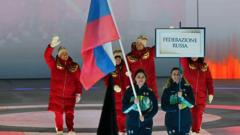
Russian athletes march at Paralympic opening ceremony
#Paralympics #Milan-Cortina #Russian athletes #Belarusian athletes #Opening ceremony #50th anniversary #National flags #Winter Games
📌 Key Takeaways
- Russian and Belarusian athletes marched under national flags at Paralympic opening
- The event marks the 50th anniversary of the Paralympic Games
- The ceremony took place at the Milan-Cortina Winter Paralympics in Italy
- Participation comes despite previous geopolitical tensions affecting their competition status
📖 Full Retelling
🏷️ Themes
Paralympics, International Relations, Sports Diplomacy
📚 Related People & Topics

National flag
Flag of a country or nation
A national flag is a flag that represents and symbolizes a given nation. It is flown by the government of that nation, but can also be flown by its citizens. A national flag is typically designed with specific meanings for its colors and symbols, which may also be used separately from the flag as a ...

Paralympic Games
Major international sport event for people with disabilities
The Paralympic Games or Paralympics is a periodic series of international multisport events involving athletes with a range of disabilities. There are Winter and Summer Paralympic Games, which since the 1988 Summer Olympics in Seoul, South Korea, have been held shortly after the corresponding Olympi...

Opening ceremony
Official opening of a building or event
An opening ceremony, grand opening, or ribbon-cutting ceremony marks the official opening of a newly constructed location or the start of an event. Opening ceremonies at significant events such as the Olympic Games, FIFA World Cup, and the Rugby World Cup might involve thousands of participants and ...
Entity Intersection Graph
No entity connections available yet for this article.
Mentioned Entities
Deep Analysis
Why It Matters
This news is significant as it marks a notable moment of international cooperation in sports, particularly for Russian and Belarusian athletes who have faced restrictions in recent competitions. Their participation under national flags at the 50th anniversary Paralympics signals a potential shift in how international sporting bodies handle geopolitical tensions. This affects athletes with disabilities who have been caught in political conflicts, as well as the broader Paralympic movement's commitment to unity and inclusion.
Context & Background
- Russia and Belarus have faced significant restrictions in international sports following the 2022 invasion of Ukraine, with many athletes banned from competition or required to compete as neutral athletes
- The International Paralympic Committee (IPC) has previously taken different stances than the International Olympic Committee (IOC) regarding Russian and Belarusian participation
- This is the 50th anniversary edition of the Winter Paralympics, which began in 1976 in Örnsköldsvik, Sweden
- The Paralympic Games have historically been a platform for promoting inclusion and equality for athletes with disabilities
- Previous major sporting events have seen Russian athletes competing under various neutral banners, such as 'Russian Olympic Committee' or 'Neutral Paralympic Athletes'
What Happens Next
Russian and Belarusian athletes will now compete in various winter sports disciplines throughout the Paralympic Games. Their performance and reception by other athletes and spectators will be closely watched as an indicator of the current international climate. Following the Games, there may be discussions within the IPC and other sporting bodies about future policies regarding athletes from nations under political sanctions.
Frequently Asked Questions
The decision reflects the International Paralympic Committee's approach to inclusion, allowing these athletes to compete under their national symbols despite geopolitical tensions. This marks a difference from some previous restrictions they faced in other international competitions.
This represents a more inclusive approach than some recent events where Russian athletes were required to compete as neutrals without national symbols. However, it's consistent with the Paralympic movement's historical emphasis on inclusion and equality.
This could set a precedent for how international sporting bodies balance geopolitical concerns with the principles of inclusion and fair competition for athletes, potentially influencing policies for upcoming events like the Paris Olympics.
The event emphasizes the core Paralympic values of excellence, determination, inspiration, and equality, showing how sports can transcend political divisions while celebrating athletic achievement.