
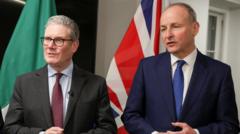
Starmer and Martin to tackle cost-of-living and security at UK-Ireland summit
#Keir Starmer #Simon Martin #UK-Ireland summit #cost-of-living #security #bilateral relations #economic crisis
📌 Key Takeaways
- UK Prime Minister Keir Starmer and Irish Taoiseach Simon Martin will meet at a UK-Ireland summit.
- The summit's agenda focuses on addressing the cost-of-living crisis.
- Security issues are also a key topic for discussion at the meeting.
- The meeting signifies ongoing bilateral cooperation between the UK and Ireland.
🏷️ Themes
Diplomacy, Economic Policy
📚 Related People & Topics

Keir Starmer
Prime Minister of the United Kingdom since 2024
# Sir Keir Starmer **Sir Keir Rodney Starmer** (born 2 September 1962) is a British politician and lawyer serving as Prime Minister of the United Kingdom since July 2024. A member of the Labour Party, he has served as Leader of the Labour Party since 2020 and has been the Member of Parliament (MP) ...
Entity Intersection Graph
No entity connections available yet for this article.
Mentioned Entities
Deep Analysis
Why It Matters
This summit matters because it addresses two critical issues affecting millions of citizens across both nations: the ongoing cost-of-living crisis that impacts household budgets and economic stability, and security concerns that affect national safety and cross-border cooperation. The meeting signals a reset in UK-Ireland relations under new UK leadership, which could influence trade, immigration policies, and diplomatic coordination. The outcomes will affect businesses, families, and security agencies in both countries, potentially shaping economic policies and cross-border security protocols for years to come.
Context & Background
- The UK and Ireland have a complex historical relationship shaped by colonialism, partition, and the Good Friday Agreement of 1998 which established peace in Northern Ireland.
- Post-Brexit tensions have strained UK-Ireland relations, particularly regarding the Northern Ireland Protocol and border arrangements.
- Both countries face shared challenges including inflation, energy security, and transnational crime, requiring coordinated policy responses.
- Previous summits have addressed issues like the Common Travel Area, trade agreements, and responses to global crises such as COVID-19 and the war in Ukraine.
What Happens Next
Following the summit, expect joint policy announcements on economic measures to address inflation and energy costs, potentially including coordinated subsidy programs or tax relief initiatives. Security agreements may lead to enhanced intelligence sharing and cross-border law enforcement operations. Diplomatic follow-up will likely involve working groups to implement agreements, with progress reviews scheduled for the next bilateral meeting in 6-12 months. The outcomes may also influence upcoming EU-UK negotiations regarding Northern Ireland arrangements.
Frequently Asked Questions
The summit will likely focus on coordinated energy price caps, food inflation controls, and social welfare adjustments. Both governments may explore joint purchasing agreements for energy resources and aligned minimum wage policies to address purchasing power disparities across borders.
This represents the first major bilateral meeting since Keir Starmer became UK Prime Minister, signaling a potential reset after years of Brexit-related tensions. The agenda appears more focused on practical domestic concerns rather than constitutional issues that dominated recent discussions.
Key security concerns include cyber threats, organized crime networks operating across borders, and maintaining stability in Northern Ireland. Both countries need to coordinate on counter-terrorism intelligence and maritime security given their shared waters and critical infrastructure.
While not explicitly focused on Northern Ireland, agreements on economic support and security cooperation will directly impact the region. Successful collaboration could create positive momentum for resolving outstanding Protocol issues and supporting the restored Northern Ireland Executive.
Closer coordination could reduce trade friction, align regulatory standards to lower business costs, and create joint investment initiatives. Coordinated economic policies might also strengthen both countries' positions in negotiations with the EU and other international partners.