
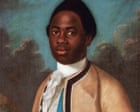
Swedish exhibition explores life of 18th-century Black diarist
📖 Full Retelling
<p>Born into slavery, Gustav Badin became part of Swedish royal court and left legacy of books and letters</p><p>In 1760, a Black child around 10 years old arrived at the Swedish royal court as a “gift” to the queen. Adolf Ludvig Gustav Fredrik Albrecht Couschi, who became known as Badin (derived from the French for joker or prankster), later held titles including chamberlain, court secretary, ballet master and civil servant.</p><p>He is thought to have been born in
Entity Intersection Graph
No entity connections available yet for this article.
Original Source
Swedish exhibition explores life of 18th-century Black diarist Born into slavery, Gustav Badin became part of Swedish royal court and left legacy of books and letters I n 1760, a Black child around 10 years old arrived at the Swedish royal court as a “gift” to the queen. Adolf Ludvig Gustav Fredrik Albrecht Couschi, who became known as Badin (derived from the French for joker or prankster), later held titles including chamberlain, court secretary, ballet master and civil servant. He is thought to have been born into slavery between 1747 and 1750 in the former Danish colony of St Croix (now part of the US Virgin Islands), where he was “owned” by Christian Lebrecht von Pröck, who took him to Denmark. He was “received” by Gustaf de Brunck, a Swedish councillor of commerce, who later “donated” Badin to Queen Louisa Ulrika. When Badin died, he left behind diaries, a vast book collection, private letters and an autobiography offering a window into his life in 18th- and 19th-century Stockholm. Yet he remains vastly under-researched and in many ways overlooked by the Swedish public, despite featuring in fictionalised form in multiple works, including a racist depiction in August Strindberg’s 1902 play Gustav III and, more recently, a ballet, Gustavia, at the Royal Swedish Opera. A landmark exhibition at the National Museum in Stockholm aims to change that by offering a fuller understanding of his life and the role he played in Swedish society. The exhibition, Badin – Beyond Surface and Mask, includes his writings, which are on display together for the first time, and a specially commissioned film by Salad Hilowle, an artist who has dedicated much of his career to Badin. Hilowle said the commission felt like a significant moment for Swedish art history to give recognition to Badin, and also for himself as an African-Swedish artist. “I’m always talking about how he was an image and he was the other and now the other is also an artist. Time has changed in Sweden . It’s a super...
Read full article at source