
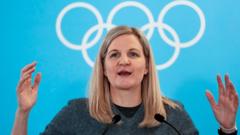
The fallout and key questions from the IOC's biological female decision
📖 Full Retelling
📚 Related People & Topics

International Olympic Committee
Governing body of Olympic sports
The International Olympic Committee (IOC) is the international, non-governmental, sports governing body of the modern Olympic Games. Founded in 1894 by Pierre de Coubertin and Demetrios Vikelas, it is based in Lausanne, Switzerland. The IOC is the authority responsible for organising the Summer, Win...
Entity Intersection Graph
Connections for International Olympic Committee:
Mentioned Entities
Deep Analysis
Why It Matters
This decision fundamentally impacts competitive fairness in women's sports by establishing eligibility criteria based on biological sex rather than gender identity. It affects transgender athletes who may be excluded from competing in women's categories, women athletes concerned about competitive integrity, and sports governing bodies worldwide that must implement these policies. The ruling represents a significant shift in international sports policy with implications for human rights debates, athletic competition structures, and the ongoing global conversation about inclusion versus fairness in sports.
Context & Background
- The International Olympic Committee (IOC) has historically grappled with gender verification policies since the 1960s, implementing various testing methods over decades
- In 2015, the IOC introduced guidelines allowing transgender women to compete in women's categories if their testosterone levels were below 10 nmol/L for at least 12 months
- Recent years have seen high-profile cases like Lia Thomas in swimming and Laurel Hubbard in weightlifting that intensified debates about transgender participation in women's sports
- Many international sports federations including World Athletics, World Aquatics, and World Rugby have implemented stricter eligibility rules in 2022-2023
- The 'biological female' definition represents a departure from the IOC's previous focus on hormone levels and represents alignment with several sport-specific federations
What Happens Next
Sports federations will need to implement the IOC's framework within their own governance structures, potentially leading to varied interpretations across different sports. Legal challenges are expected from athletes and advocacy groups, particularly under human rights and anti-discrimination laws in various jurisdictions. The 2024 Paris Olympics will serve as the first major test of these policies at the elite international level, with potential appeals and arbitration cases likely to emerge during qualification periods.
Frequently Asked Questions
The IOC's definition refers to athletes whose sex was assigned female at birth and who have not undergone male puberty. This represents a shift from previous policies that focused primarily on testosterone levels, now emphasizing chromosomal and developmental biological factors.
Transgender women who have undergone male puberty will likely be excluded from women's categories in Olympic sports. Transgender men may face different considerations, potentially being allowed to compete in men's categories with appropriate medical oversight.
No, while the IOC provides a framework, individual international federations maintain autonomy to implement specific rules for their sports. Some may adopt stricter interpretations while others might seek exemptions or modified approaches based on sport-specific characteristics.
The IOC has indicated DSD athletes will be addressed through separate policies, though details remain unclear. Previous cases like Caster Semenya suggest DSD regulations may involve hormone suppression requirements rather than outright exclusion.
Yes, national Olympic committees, sports federations, and athlete groups can appeal through the Court of Arbitration for Sport. Individual countries may also implement conflicting policies for domestic competitions, creating potential conflicts for international events.
This remains an unresolved question. Sports organizations will need to determine whether records set under previous eligibility rules will stand or be reclassified, potentially creating complex historical record-keeping challenges across multiple sports.