
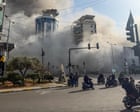
‘The memories stay behind’: hundreds of thousands flee the Israeli bombs in Beirut
#Beirut #Israeli airstrikes #evacuation #displacement #humanitarian crisis #civilians #conflict
📌 Key Takeaways
- Hundreds of thousands of civilians are evacuating Beirut due to Israeli airstrikes.
- The evacuation highlights the human cost and displacement caused by the conflict.
- Residents are forced to leave personal belongings and memories behind.
- The situation underscores escalating tensions and humanitarian crisis in the region.
📖 Full Retelling
🏷️ Themes
Conflict, Displacement
📚 Related People & Topics

Beirut
Capital and largest city of Lebanon
Beirut ( bay-ROOT; Arabic: بيروت, romanised: ) is the capital and largest city of Lebanon. As of 2025 Greater Beirut has a population of 2.4 million, just under half of Lebanon's population, which makes it the twelfth-largest city in the Levant region and the sixteenth-largest in the Arab world. Th...

Israeli Air Force
Aerial and space service branch of the Israel Defense Forces
The Israeli Air Force (IAF; Hebrew: זְרוֹעַ הָאֲוִיר וְהֶחָלָל, romanized: Zroa HaAvir VeHahalal, lit. 'Air and Space Arm', commonly known as חֵיל הָאֲוִיר, Kheil HaAvir, "Air Corps") operates as the aerial and space warfare branch of the Israel Defense Forces (IDF). It was founded on May 28, 1948,...
Entity Intersection Graph
Connections for Beirut:
Mentioned Entities
Deep Analysis
Why It Matters
This news highlights a major humanitarian crisis with hundreds of thousands of civilians displaced by Israeli airstrikes in Beirut, creating urgent needs for shelter, food, and medical care. It represents a significant escalation in regional conflict that could destabilize Lebanon further and strain international diplomatic relations. The displacement affects vulnerable populations including children, elderly, and those with limited resources, while also raising concerns about civilian casualties and long-term trauma from forced displacement.
Context & Background
- Beirut has experienced multiple conflicts including the 2006 Israel-Hezbollah war that caused widespread destruction and displacement
- Lebanon has been facing severe economic crisis since 2019 with hyperinflation, currency collapse, and widespread poverty affecting basic services
- Tensions between Israel and Hezbollah have been escalating along the Lebanon-Israel border with regular exchanges of fire since October 2023
- Lebanon hosts approximately 1.5 million Syrian refugees alongside Palestinian refugee communities, creating additional strain on infrastructure
- Beirut is still recovering from the devastating 2020 port explosion that killed over 200 people and damaged large parts of the city
What Happens Next
International organizations will likely mobilize emergency aid for displaced populations while diplomatic efforts intensify to prevent further escalation. Lebanon's government may declare a state of emergency and request international assistance. The situation could lead to increased pressure on neighboring countries like Cyprus, Syria, and Jordan to accept refugees if displacement continues. Military analysts will monitor whether this represents a limited operation or the beginning of broader Israeli military action in Lebanon.
Frequently Asked Questions
Israeli military operations in Beirut typically target Hezbollah infrastructure and leadership positions, as Israel considers the group a terrorist organization and security threat. The current bombing campaign likely responds to recent attacks or intelligence about imminent threats from Hezbollah forces based in Lebanon.
Displaced Beirut residents are likely moving to safer areas within Lebanon, including rural regions, mountainous areas, or southern cities away from conflict zones. Some may seek shelter with relatives, in schools or public buildings converted to shelters, or attempt to cross borders if neighboring countries permit entry.
The displacement will further strain Lebanon's collapsed economy by disrupting remaining economic activity, increasing demand for scarce resources, and potentially causing additional currency depreciation. Humanitarian needs will divert limited government resources from economic recovery efforts already hampered by years of crisis.
The UN and humanitarian agencies are likely mobilizing emergency response teams while diplomatic channels work to de-escalate tensions. Countries with citizens in Lebanon may begin evacuation operations, and regional powers will engage in shuttle diplomacy to prevent broader conflict.
This escalation in Lebanon is connected to the Gaza conflict as Hezbollah has been exchanging fire with Israel in solidarity with Hamas. The Beirut bombing represents potential expansion of the regional conflict beyond Gaza, raising concerns about multi-front war involving Iranian-backed groups across the Middle East.